
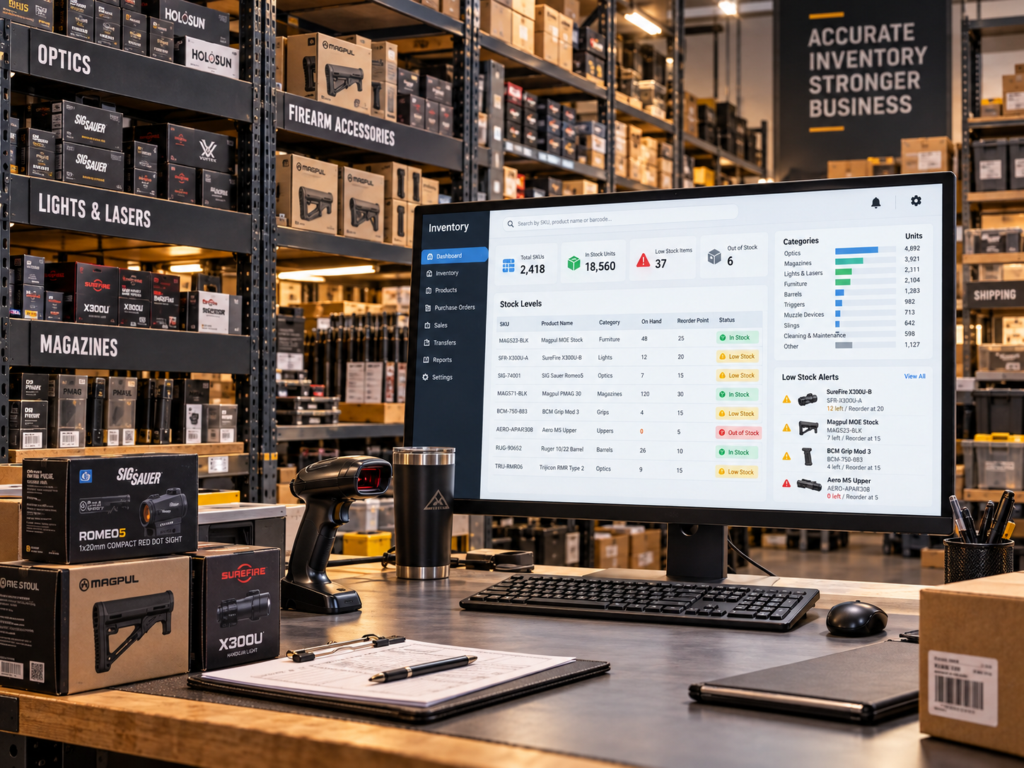
Inventory is one of the hardest parts of running a firearms retail business. A dealer may have products on the sales floor, items in the warehouse, online orders in progress, distributor inventory available through feeds, and products moving between multiple sales channels.
That complexity is exactly why gun inventory software matters.
When inventory is managed manually, small errors can quickly become expensive. A product may appear available online after it has already sold in the store. A distributor may run out of an item while the website still shows it as available. Staff may waste time reconciling spreadsheets, POS records, ecommerce orders, and supplier data.
The goal of gun inventory software is to create a more accurate, connected view of what can actually be sold.
What Is Gun Inventory Software?
Gun inventory software is technology that helps firearms retailers track, organize, synchronize, and manage product inventory across their business.
Depending on the platform, it may help manage:
- In-store stock
- Ecommerce inventory
- Distributor feeds
- Product SKUs
- Categories and attributes
- Stock status
- Reorder levels
- Multi-location inventory
- Order allocation
- Product pricing
- Reporting
- POS synchronization
The strongest systems do more than show a quantity on a screen. They help keep inventory information aligned across the places where products are sold.
For an FFL with both a physical location and an ecommerce website, that synchronization can become one of the most important parts of the technology stack.
Why Inventory Accuracy Matters
Inventory accuracy directly affects customer experience.
If a customer sees a product online, places an order, and then learns that the item is unavailable, trust is damaged. The same issue occurs when store staff promise an item that has already been allocated to an online order.
Good gun inventory software reduces the chance that two sales channels are competing for the same unit.
It can also make internal operations easier.
Instead of checking multiple systems, employees should be able to quickly understand whether a product is available, where it is located, whether more units are expected, and whether a distributor has additional stock.
That visibility saves time and helps employees make better decisions.
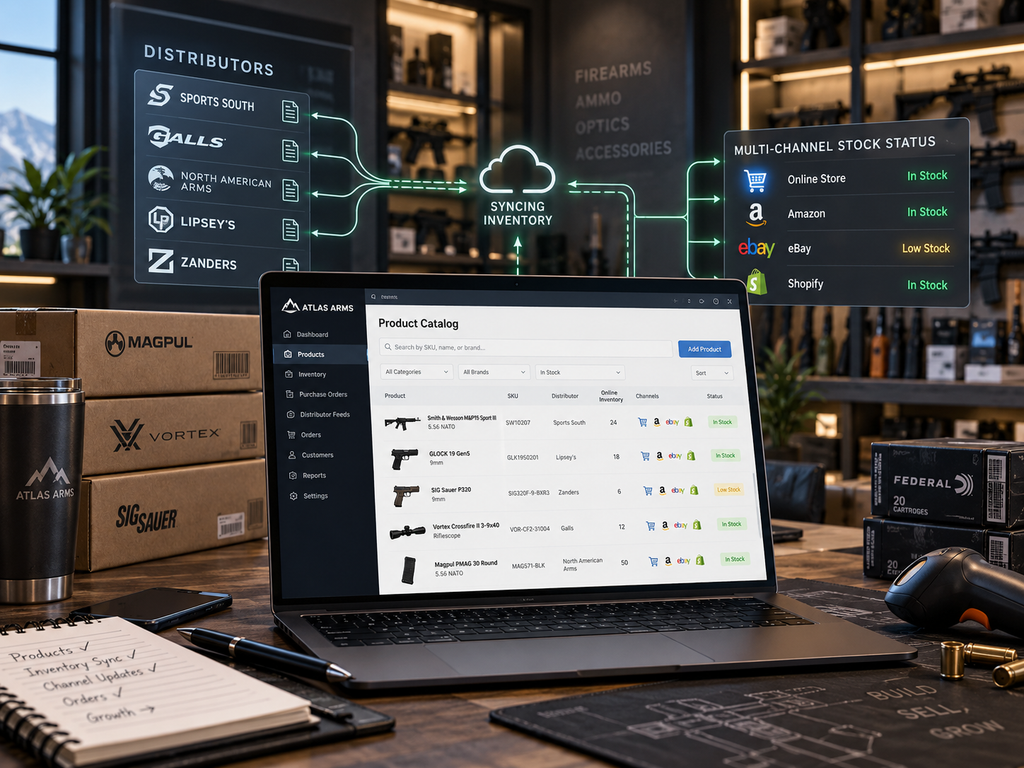
Connecting In-Store and Online Inventory
For many firearms dealers, the most important inventory challenge is connecting the physical store to the ecommerce website.
The POS may record one quantity while the website records another.
Without synchronization, staff members may need to manually update ecommerce inventory after every in-store sale. That approach may work for a very small catalog, but it becomes increasingly difficult as product volume grows.
Gun inventory software should help the business establish a reliable synchronization process.
When an item sells at the counter, online availability should update. When an online order reserves the last available unit, store staff should be able to see that change before selling it again.
The objective is not simply faster updates. The objective is having one dependable inventory logic across every sales channel.
Retailers with a physical storefront should also evaluate how gun store POS software keeps in-store transactions synchronized with ecommerce inventory.
Managing Distributor Inventory
Distributor feeds can dramatically expand an online firearms catalog.
A dealer may physically stock hundreds or thousands of products while distributors provide access to many thousands more.
That creates opportunity, but it also creates complexity.
Gun inventory software needs to distinguish between dealer-owned inventory and inventory available from outside suppliers.
Those are not the same thing.
A product physically inside the store may be ready for immediate fulfillment. A distributor-supplied product depends on the distributor’s current availability, fulfillment rules, pricing, and account relationship.
A broader gun shop software stack can help connect distributor feeds with ecommerce, inventory, payments, shipping, and other operational systems.
A strong inventory system should make those differences clear.
Working With Multiple Distributors
Many firearms dealers work with more than one distributor.
The same SKU may be available from several suppliers at different costs and quantities.
That creates another challenge for gun inventory software: deciding how multiple inventory sources should be represented on the ecommerce site.
A retailer may want to prioritize local inventory first, then a preferred distributor, then another supplier if the first two sources are unavailable.
The system may also need rules around margin, shipping, lead time, or minimum stock.
Without those rules, a dealer can end up with duplicate listings or confusing product availability.
The software should help transform supplier data into a clean customer-facing catalog.
Product Data Is Part of Inventory Management
Inventory is not only about quantity.
Every product also has data attached to it.
That can include:
- SKU
- UPC
- Manufacturer
- Model
- Category
- Caliber
- Product type
- Images
- Description
- Cost
- Retail price
- Weight
- Dimensions
- Stock source
Effective gun inventory software should help organize this information consistently.
Poor product data creates problems throughout an ecommerce site.
Duplicate products make search difficult. Inconsistent categories weaken navigation. Missing images lower conversion rates. Incorrect attributes make filters unreliable.
Inventory management and catalog management therefore need to work together.
Preventing Overselling
Overselling is one of the clearest signs that inventory systems are not properly connected.
It usually happens when inventory updates are delayed or when separate systems believe they control the same available stock.
Gun inventory software can reduce this risk by updating stock as transactions happen and by allocating inventory appropriately.
For example, the last item in stock should not remain freely available online after an in-store transaction has already consumed it.
The same applies to distributor inventory.
If a supplier feed shows zero available units, the ecommerce store should respond according to the dealer’s rules rather than continuing to accept orders blindly.
No inventory system can eliminate every exception, but automation can dramatically reduce unnecessary errors.
Real-Time vs. Scheduled Inventory Sync
Not every integration updates inventory in the same way.
Some systems exchange data nearly in real time. Others update on a schedule every few minutes, hourly, or several times per day.
When evaluating gun inventory software, dealers should understand how synchronization actually works.
The faster option is not always automatically better.
A retailer with a small amount of fast-moving local inventory may need frequent synchronization. Distributor catalogs with tens of thousands of products may use scheduled updates to balance accuracy and system performance.
What matters is matching the update frequency to the risk of inventory becoming inaccurate.
Inventory Rules and Safety Stock
Some retailers intentionally avoid making every available unit sellable online.
For example, a dealer may keep one unit reserved for in-store customers or use a safety-stock rule to account for synchronization delays.
Gun inventory software can support that strategy by separating physical quantity from sellable quantity.
If five units exist but the business only wants four displayed as available online, the inventory logic should support that decision.
These rules can be especially helpful when inventory moves quickly or when the retailer has multiple sales channels.
Low-Stock and Reorder Visibility
Inventory software should not only tell the dealer what has already sold.
It should also help identify what needs attention next.
Gun inventory software can make low-stock products easier to identify so purchasing decisions are based on actual sales activity rather than guesswork.
Retailers may want alerts when products fall below specific thresholds.
The ideal threshold will vary by product.
A high-volume accessory might need to be reordered when 20 units remain. A slower-moving high-value product may have a completely different threshold.
The important point is that inventory data should help purchasing become more intentional.
Inventory Reporting
Good reporting turns inventory data into business intelligence.
A dealer should be able to identify which products sell quickly, which sit on the shelf, which categories generate revenue, and which products repeatedly go out of stock.
Gun inventory software should help answer questions such as:
- What are the fastest-moving products?
- Which SKUs have not sold recently?
- Which categories are growing?
- What inventory is frequently unavailable?
- Which distributor products generate orders?
- Which products tie up the most capital?
- Where are stock discrepancies occurring?
These insights can improve purchasing decisions and reduce unnecessary inventory costs.
Dead Stock and Slow-Moving Products
Not every product deserves equal shelf space or purchasing attention.
Slow-moving inventory ties up cash.
When retailers lack good reporting, these products can remain unnoticed for months.
Gun inventory software can help identify stock that is not moving.
That allows the dealer to decide whether to reduce future purchasing, promote the item, adjust pricing, improve merchandising, or discontinue it.
Inventory optimization is not only about having enough products.
It is also about avoiding too much of the wrong inventory.
Inventory and Ecommerce Search
Accurate inventory data also improves the online shopping experience.
Customers do not want to browse pages filled with products that cannot actually be purchased.
When gun inventory software is connected to ecommerce, the site can use stock status as part of merchandising.
Available products can be prioritized. Unavailable products can be handled according to the retailer’s SEO and merchandising strategy. Filters can help shoppers narrow the catalog to products they can actually buy.
This creates a cleaner buying experience while preserving the value of a large product catalog.
Managing Large Product Catalogs
Large firearms ecommerce stores can contain tens of thousands of products.
At that scale, inventory management becomes both an operational and technical challenge.
Gun inventory software needs to handle large quantities of data without making the website difficult to manage.
Importing every supplier product without rules can create duplicate SKUs, inconsistent categories, poor descriptions, thin product pages, and unnecessary database load.
Retailers should therefore decide which products actually belong in the catalog.
More products do not automatically mean more sales.
A controlled catalog is usually more valuable than an enormous unmanaged one.
Inventory and Pricing
Cost changes can affect profitability quickly.
Distributor pricing may change, shipping costs may change, and product margins can vary substantially between categories.
For that reason, gun inventory software often needs to work closely with pricing rules.
A dealer may use fixed margins, percentage markups, minimum profit rules, or category-specific pricing logic.
Whatever method is used, the business should avoid situations where supplier cost changes make products unintentionally unprofitable.
Inventory and pricing data need to remain connected.
Multi-Location Inventory
Dealers with more than one physical location face another layer of complexity.
A product may be available at one store but unavailable at another.
Gun inventory software should make location-specific inventory clear when multiple stores, warehouses, or fulfillment points are involved.
The ecommerce platform may then use that information for fulfillment decisions, store pickup, or availability messaging.
A multi-location business needs more than one total stock number.
It needs to know where that stock actually exists.
Inventory Security and Permissions
Inventory adjustments should be controlled.
Not every employee needs permission to modify quantities, costs, product data, or synchronization rules.
Good gun inventory software should support user permissions appropriate to the retailer’s workflow.
That can make it easier to understand who made changes and reduce accidental edits.
As a dealer grows, clear permissions become increasingly important because more employees interact with the same systems.
Dealers comparing their wider technology stack should also review what gun store software needs to support across inventory, POS, ecommerce, reporting, and staff access.
Distributor Relationships Still Matter
Software can automate distributor information, but the underlying supplier relationship remains important.
Distributors have their own account requirements, pricing, ordering systems, stock availability, and fulfillment options.
For example, RSR Group dealer materials document account options for firearms and accessories dealers along with fulfillment and dropship services.
A dealer should understand how each distributor operates before deciding how its inventory should appear online.
Technology should reflect the supplier relationship rather than hide it.
How to Choose Gun Inventory Software
The best platform depends on how the dealer actually sells.
Before choosing gun inventory software, document the current inventory workflow from purchase to sale.
Identify:
- Where inventory data originates
- Which POS system is used
- Which ecommerce platform is used
- Which distributors are connected
- How often inventory changes
- Whether multiple locations are involved
- How orders reserve stock
- How pricing is updated
- Who can modify inventory
- How discrepancies are handled
Then evaluate platforms against those needs.
The most important question is not how many inventory features the software advertises.
It is whether the software creates a dependable source of truth for the business.
Build Inventory Around Integration
Inventory touches almost every part of a firearms retail operation.
It affects ecommerce, POS, purchasing, distributors, pricing, fulfillment, reporting, customer experience, and cash flow.
That is why gun inventory software should not be treated as an isolated tool.
It should be part of a connected firearms commerce stack.
When inventory information moves correctly between systems, employees spend less time correcting data and customers see more accurate product availability.
The inventory layer becomes much more effective when FFL software integrations connect ecommerce, POS, distributor data, compliance systems, and fulfillment tools.
For growing FFL dealers, that can translate into fewer canceled orders, more efficient purchasing, cleaner operations, and a better ecommerce experience.
The objective is simple: know what you have, know where it is, know what can be sold, and make that information reliable everywhere the customer interacts with the business.
For a broader overview of how these systems fit together, see our complete guide to FFL software
Frequently Asked Questions
What is gun inventory software?
Gun inventory software helps firearms retailers track and synchronize product inventory across physical stores, ecommerce websites, distributors, warehouses, and other sales channels.
Can gun inventory software connect with distributor feeds?
Yes. Gun inventory software can connect with distributor data depending on the platform and supplier. Dealers should understand how often inventory updates and how distributor stock differs from locally owned inventory.
Can gun inventory software prevent overselling?
Gun inventory software can significantly reduce overselling when POS, ecommerce, and supplier inventory are synchronized correctly. Dealers should still configure stock-allocation and synchronization rules that fit their sales volume.
Does inventory software work with a gun store POS?
Many inventory platforms can integrate with POS systems or exchange stock information through connectors. Compatibility should be verified before selecting a system.
What should an FFL look for in inventory software?
Look for accurate synchronization, ecommerce and POS integration, distributor-feed support, strong product-data management, stock rules, reporting, pricing controls, permissions, and the ability to scale with larger catalogs or additional locations.