
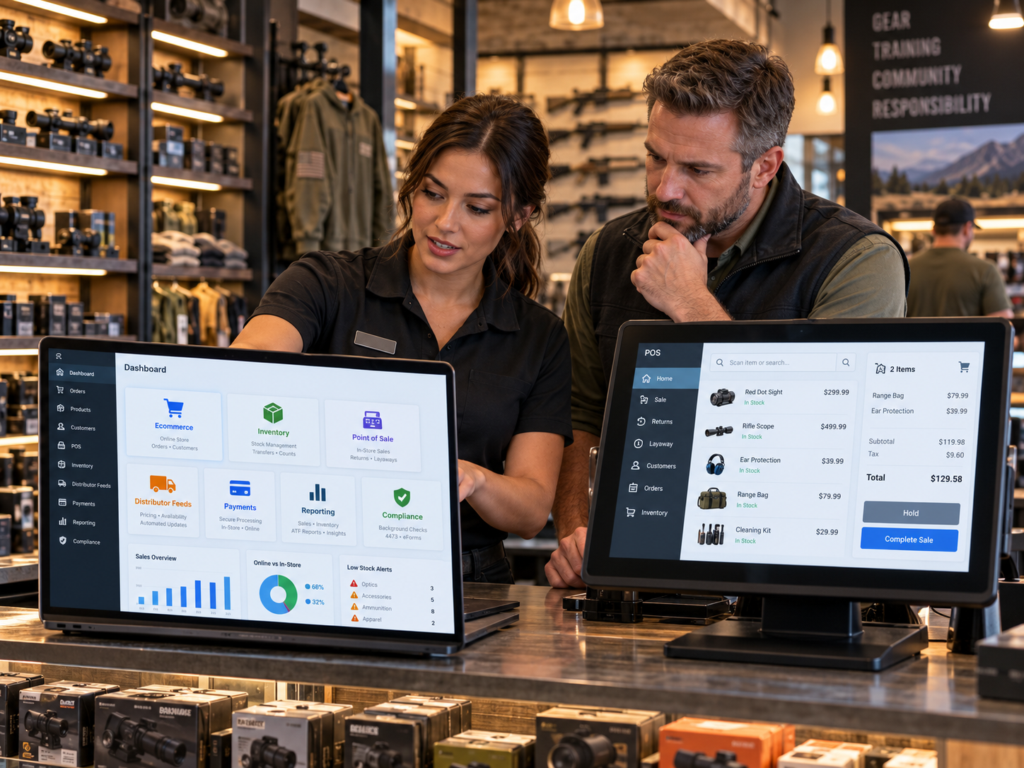
Retail technology is most valuable when it connects the systems a firearms retailer already depends on. A dealer may have a website, POS, inventory source, distributor feeds, payment processor, shipping tools, analytics, marketing platforms, and dedicated compliance software.
The challenge is not simply owning those tools. The challenge is making them work together.
That is the role of a connected retail platform.
When systems are disconnected, employees become the bridge. They copy order information, compare stock counts, update product data, reconcile payments, and check several dashboards before they can answer a customer question.
The right platform should reduce that friction by creating a connected operating environment.
What Is Firearms Retail Software?
Gun shop software is technology used to manage or connect the day-to-day systems of a firearms retail business.
Depending on the platform, it may support:
- Ecommerce
- Point of sale
- Inventory
- Distributor feeds
- Customer records
- Payments
- Shipping
- Reporting
- Marketing
- Compliance integrations
The key word is integration.
A dealer does not necessarily need one application that tries to perform every function. In many cases, the better strategy is to use specialized tools and connect them through a flexible commerce platform.
That is why gun shop software should be evaluated as part of a stack rather than as a stand-alone application.
Ecommerce Should Be the Customer-Facing Hub
For dealers selling online, ecommerce is the part of the system customers see most often.
The website needs to present products accurately, handle eligible purchases, support search and filtering, communicate order status, capture customer information, and provide a foundation for SEO and marketing.
Good gun shop software should connect ecommerce to the systems behind the scenes.
If the website says a product is available, that information should reflect inventory logic the business actually trusts.
If an order is placed, the relevant systems should receive the information required to process it.
The storefront is not separate from operations. It is one of the main entry points into the operation.
Connect POS and Ecommerce
Physical and online retail should not operate as two isolated businesses.
A customer may find a product online and purchase it in-store. Another customer may place an ecommerce order for a product that store staff also see at the counter.
Gun shop software should help keep those channels aligned.
The most obvious connection is inventory.
When an item sells in-store, online stock should update according to the retailer’s synchronization rules. When an online order allocates inventory, staff should be able to see that change before another sale creates a conflict.
Dealers should also evaluate gun store POS software based on how well it synchronizes in-store transactions, ecommerce orders, customer activity, and inventory.
The closer POS and ecommerce work together, the less manual reconciliation the dealer needs.
Inventory Must Have a Clear Source of Truth
Every connected retail system depends on reliable inventory.
A dealer may have local stock, multiple store locations, warehouse inventory, distributor availability, and open customer orders at the same time.
Good gun shop software should help the business determine what quantity is actually sellable.
That may require rules around:
- Local stock
- Reserved stock
- Safety stock
- Distributor inventory
- Multi-location quantities
- Pending orders
- Product availability
The objective is not simply to display numbers.
It is to create inventory logic that every connected system can use consistently.
Distributor Feeds Need Control
Distributor feeds can expand an ecommerce catalog quickly, but they can also create operational problems if the data is imported without rules.
A feed may contain thousands of products with different costs, quantities, categories, images, and descriptions.
Gun shop software should help the retailer control what gets published.
The dealer may need rules for margins, preferred distributors, product categories, stock thresholds, duplicate SKUs, and which products should remain hidden.
For deeper inventory planning, see how gun inventory software helps connect local stock, distributor availability, ecommerce, and multi-location inventory.
A large catalog is only useful when it stays accurate and manageable.
Integration Is More Important Than Feature Count
Software vendors often compete by listing features.
But an isolated feature may have little value if it does not connect to the rest of the business.
Gun shop software should be judged by how well it moves the right information between systems.
For example, ecommerce software may need to exchange product, order, customer, or inventory data with external services.
WooCommerce documents that its REST API can connect an online store with external systems and services, while its developer documentation covers store data including products, orders, customers, coupons, and shipping zones.
That is one reason API access matters when evaluating an extensible ecommerce platform.
A broader FFL software integrations strategy can connect ecommerce, POS, compliance platforms, distributor feeds, shipping, and reporting tools.
A system that can integrate cleanly is easier to adapt as the dealer’s needs change.
Compliance Systems Should Stay Specialized
Firearms compliance deserves dedicated attention.
A dealer may use specialized software for acquisition and disposition records, transfer workflows, Form 4473 processes, or other regulated functions.
Gun shop software should not be selected with the assumption that the ecommerce or POS platform must replace those specialized tools.
Instead, the operational stack should fit around them.
The goal is to avoid unnecessary duplicate entry while keeping compliance functions inside systems designed for those tasks.
Dealers should verify the exact capabilities of every integration and continue to follow applicable legal and regulatory requirements independently.
Payment Processing Must Fit the Industry
A firearms retailer cannot evaluate payment processing exactly like a conventional online store.
Processor policies differ, and not every provider supports every firearms-related business model or product category.
Gun shop software should therefore provide enough payment flexibility to work with appropriate providers.
Dealers should evaluate:
- Processor compatibility
- Gateway support
- Transaction fees
- Platform fees
- Chargeback handling
- Hardware requirements
- Contract terms
- Restrictions
The cheapest advertised rate is not necessarily the best fit if the payment stack creates operational risk or limits the products the business can support.
Shipping Should Be Connected to Order Data
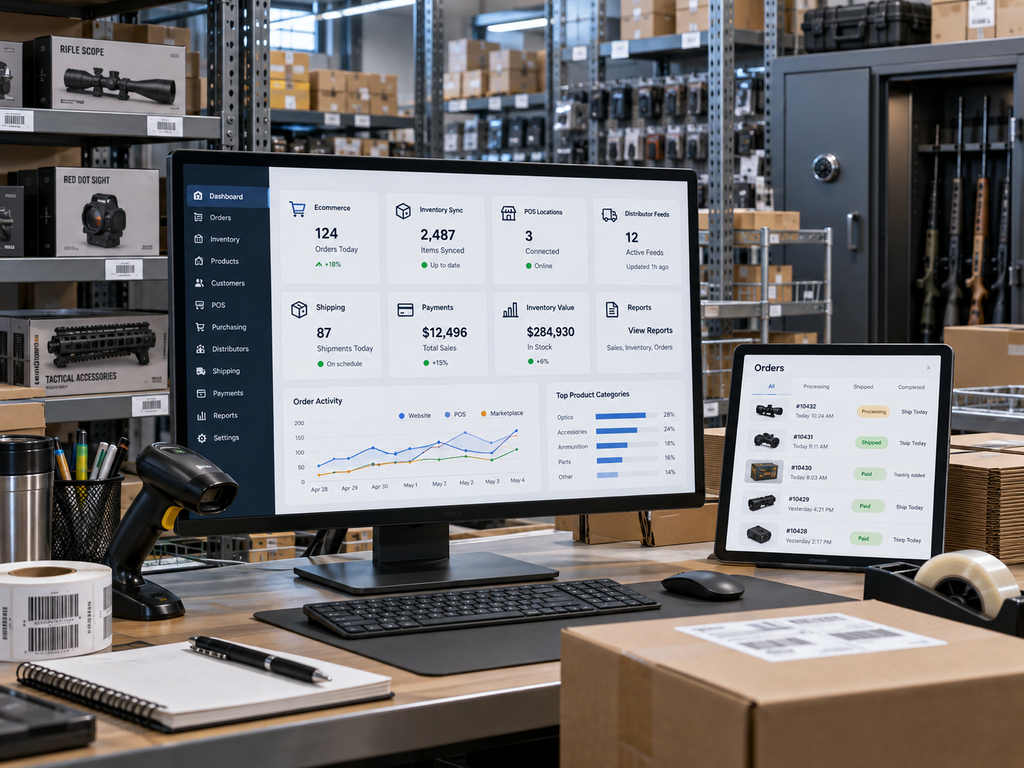
Shipping is another area where integration matters.
Employees should not need to copy customer and order details manually into a separate fulfillment system every time an order is ready to ship.
Good gun shop software should connect order information to the shipping workflow where appropriate.
That can reduce mistakes and improve customer communication.
Different product categories may require different fulfillment rules, so the technology should support flexible workflows rather than forcing every order through the same process.
Customer Data Should Move With the Business
Customers interact with a firearms retailer in more than one place.
They may browse the website, purchase in-store, place an ecommerce order later, subscribe to email, or contact support.
Gun shop software should help the business maintain useful customer context across those interactions where appropriate.
That does not mean every employee needs unlimited access to every piece of information.
It means the business should avoid unnecessary customer duplication and disconnected records.
Connected customer data can improve service, marketing, order lookup, and repeat-purchase opportunities.
Reporting Should Combine the Right Data
A firearms retailer needs more than a daily sales total.
Management may want to know:
- Which channels generate revenue?
- Which categories sell best online?
- Which products move fastest in-store?
- Which distributor products convert?
- Which inventory is sitting too long?
- Which marketing sources produce customers?
- Where are orders getting delayed?
Gun shop software should make this data easier to access.
Some information may live in the POS, some in ecommerce, and some in analytics.
The important point is that the systems can be connected well enough to create a useful view of performance.
Marketing Needs Access to the Commerce Platform
Retail technology should support growth as well as operations.
An ecommerce team may need to create landing pages, optimize category pages, improve SEO, run promotions, build email campaigns, add tracking, and test conversion changes.
Gun shop software that locks the website into a rigid environment can make those improvements more difficult.
A flexible platform allows marketing and operations to coexist.
The store can maintain structured inventory and order workflows while still giving the business room to improve content, search visibility, and conversion rates.
APIs Matter for Long-Term Flexibility
Integrations change over time.
A dealer may replace a POS, add a distributor, switch shipping tools, change marketing systems, or build a custom workflow.
That is why gun shop software should provide a practical way for external systems to connect.
APIs, webhooks, export tools, and established integrations can all make a platform more adaptable.
No dealer can predict every application the business will use five years from now.
The safer strategy is to choose technology that can exchange data instead of trapping it.
User Permissions Should Match Employee Roles
Connected systems can contain sensitive business information.
Not every employee needs access to payments, reports, integrations, pricing rules, customer exports, or configuration settings.
Gun shop software should support role-based access where possible.
Employees should receive the access they need to do their jobs without automatically receiving control over the entire system.
Clear permissions become increasingly important as the team grows.
Avoid Duplicate Data Entry
One of the easiest ways to identify a weak technology stack is to look for information that employees enter more than once.
If staff manually copy an online order into another system, re-enter customer data at the POS, update stock in several places, or recreate shipping information, there is probably an integration opportunity.
Good gun shop software should reduce those repetitive tasks.
Every manual handoff creates another chance for mistakes.
Automation does not need to remove people from the process. It should remove unnecessary repetition so employees can focus on exceptions and customer service.
Think About Failure Scenarios
Integrations are valuable, but dealers also need to know what happens when something fails.
What happens if a distributor feed stops updating?
What happens if the POS loses connectivity?
What happens if a payment gateway is unavailable?
What happens if an inventory sync produces an error?
Gun shop software should make failures visible rather than allowing them to go unnoticed.
Logs, alerts, retry mechanisms, status dashboards, and clear support processes can become just as important as the integration itself.
Plan for Catalog Growth
A small dealer may begin with a few hundred products.
Once distributor feeds are added, the catalog can grow dramatically.
Gun shop software needs to remain manageable at that scale.
The ecommerce platform should support efficient product search, filtering, category management, bulk updates, inventory synchronization, and large data sets.
Performance also matters.
A system that works well with 500 products may behave very differently with 50,000.
Scalability should be evaluated before the catalog becomes difficult to move.
Multi-Location Businesses Need Better Connections
A retailer with multiple stores or warehouses needs location-specific visibility.
Gun shop software should help distinguish where inventory exists and which location is responsible for a transaction or fulfillment task.
A combined total is not always enough.
Employees may need to transfer inventory between stores, fulfill online orders from specific locations, or compare performance by location.
Connected location data makes those decisions easier.
Build Around the Workflow, Not the Vendor
The most important step comes before choosing software.
Map the workflow.
Document what happens when:
- Inventory arrives.
- A product is added to the catalog.
- Distributor availability changes.
- A customer buys in-store.
- A customer buys online.
- An order needs fulfillment.
- Customer support needs information.
- Management needs a report.
Then evaluate gun shop software against that process.
Dealers comparing the wider retail stack should also review what gun store software needs to support across operations, staff workflows, inventory, ecommerce, and reporting.
This exposes gaps that feature lists often hide.
A Connected Stack Creates Operational Leverage
The best technology stack is not necessarily the one with the fewest applications.
It is the one with the fewest unnecessary handoffs.
Gun shop software can connect ecommerce, POS, inventory, distributor feeds, payments, shipping, marketing, reporting, and specialized compliance systems without forcing employees to manage every connection manually.
That creates leverage.
The business can handle more products, more orders, and more customers without increasing administrative work at the same rate.
For the broader technology framework behind these systems, read our complete guide to FFL software.
For growing firearms retailers, that operational efficiency can become a major competitive advantage.