
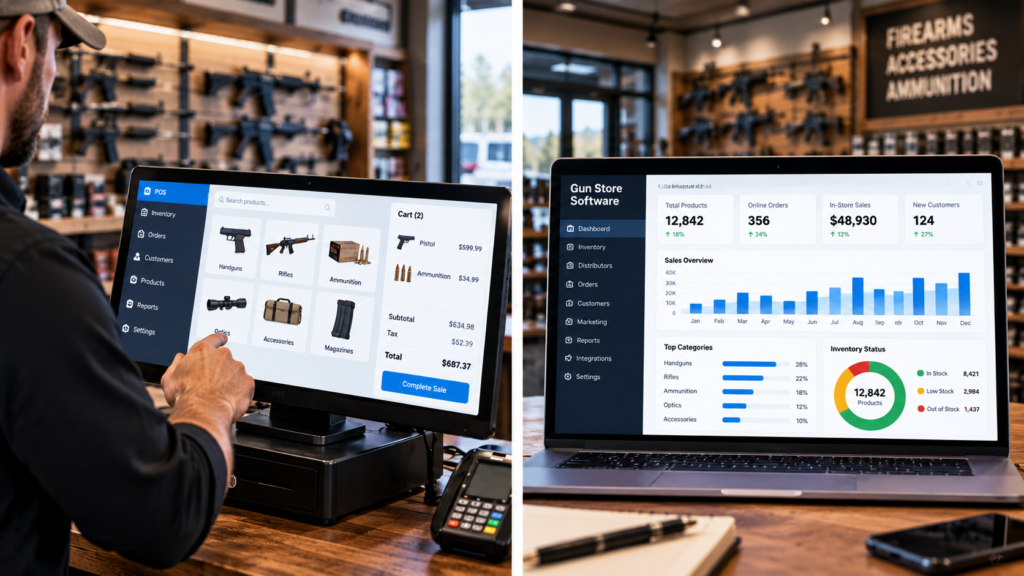
Running a modern firearms retail business involves far more than ringing up transactions at a counter. Dealers may manage thousands of products, multiple distributors, online orders, physical inventory, payment processing, shipping, marketing, customer communication, and regulatory workflows at the same time.
That complexity is why choosing the right gun store software matters.
The problem is that firearms dealers are often presented with software based on long feature lists rather than on how their businesses actually operate. A platform may offer dozens of features yet still force employees to move information manually between ecommerce, point-of-sale, inventory, and compliance systems.
The better approach is to evaluate technology around the dealer’s complete workflow.
Good gun store software should make the business easier to operate, connect the systems that matter, reduce unnecessary manual work, and provide enough flexibility to grow as the retailer expands.
What Is Gun Store Software?
Gun store software is technology used to manage some or all of the operational functions of a firearms retail business.
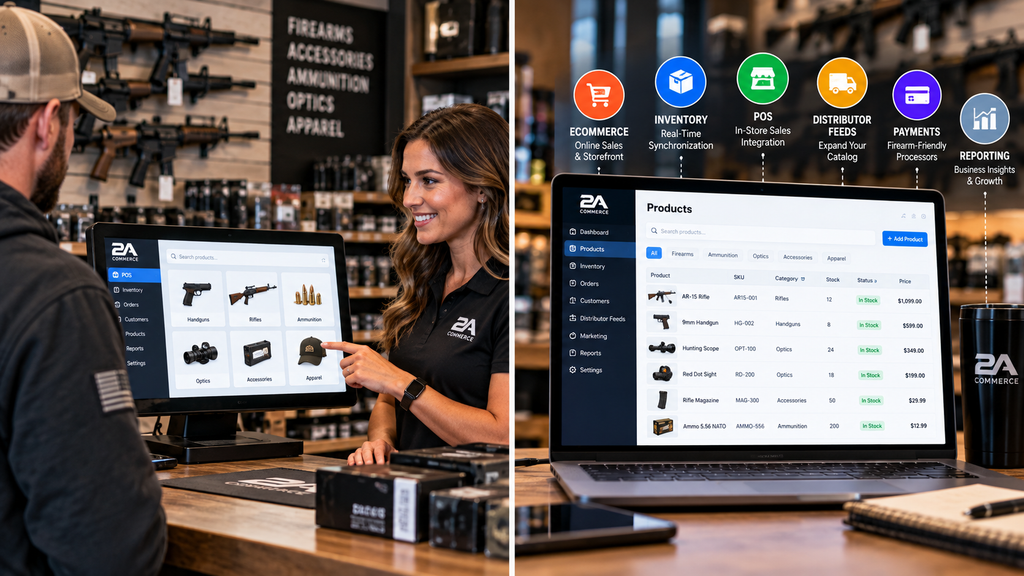
Depending on the platform, those functions may include:
- Inventory management
- Point-of-sale operations
- Ecommerce
- Distributor feeds
- Order management
- Customer management
- Payment processing
- Shipping
- Reporting
- Marketing integrations
- Connections with specialized FFL compliance systems
The important distinction is that gun store software does not necessarily need to perform every one of these functions itself.
In many cases, the strongest technology stack combines specialized applications and connects them through integrations.
A dealer might use one system for ecommerce, another for POS, a dedicated compliance platform for regulated recordkeeping, and another service for shipping. What matters is whether those systems can work together efficiently.
Start With the Dealer’s Actual Workflow
Before comparing platforms, map how information moves through the business.
Imagine a customer purchasing a product from a firearms retailer.
The product may have originated from a distributor feed. Its availability must be reflected on the website. The customer may find it through Google, place an order online, make a payment, receive communications, and eventually complete the appropriate fulfillment process.
Meanwhile, employees need visibility into inventory, orders, customer information, and transaction status.
If each part of that process exists in a separate system with no communication between them, employees become the integration.
They copy data, update quantities, check multiple dashboards, and correct inconsistencies.
Effective gun store software should eliminate as much of that repetitive work as possible.
Inventory Management Should Be Central
Inventory is one of the most important functions for any firearms retailer.
A store may carry firearms, ammunition, optics, magazines, apparel, accessories, safes, parts, cleaning supplies, and many other products.
Inventory becomes even more complicated when products are sold both online and inside a physical location.
The right gun store software should help employees understand what is actually available.
When something sells in the store, ecommerce availability should update appropriately. When an online order consumes available inventory, staff should not discover later that the same product was sold over the counter.
The objective is a synchronized inventory environment rather than multiple competing versions of stock information.
Dealers that need deeper control over stock synchronization should also review how gun inventory software connects local inventory, ecommerce, POS activity, and distributor availability.
Distributor Feeds Can Expand the Catalog
Distributor integrations can allow firearms retailers to present significantly more products online than they physically stock.
That can be valuable, but only when the feed is manageable.
A distributor may provide thousands or tens of thousands of products. Simply importing all of them into a website can create problems with navigation, pricing, duplicate products, product information, and inventory management.
Useful gun store software should give the retailer control over what happens to distributor data.
Dealers should be able to determine which products are published, which categories they belong to, how margins are calculated, how availability is updated, and which distributor should fulfill an order when the same product exists in multiple feeds.
The goal is not the largest possible catalog.
The goal is a profitable and manageable catalog.
Ecommerce Should Be More Than a Product List
Some firearms retailers still treat their website as a digital version of the store shelf.
That misses much of the opportunity ecommerce provides.
A modern website needs product search, filtering, category architecture, landing pages, analytics, SEO, content, customer accounts, email capture, conversion tracking, and merchandising tools.
For this reason, gun store software should connect with an ecommerce platform capable of supporting marketing as well as transactions.
A dealer’s website should be able to attract people who have never heard of the business before.
Search engines can bring users directly to category pages, product pages, educational resources, dealer services, and other high-intent content.
Once that traffic arrives, the ecommerce experience needs to convert it into customers.
POS and Ecommerce Need to Communicate
The physical counter and the website are no longer completely separate sales environments.
Customers often research online before visiting a store. They may check inventory from their phone while standing in the parking lot. They may buy accessories online after purchasing a firearm in person.
That makes POS integration a significant consideration when selecting gun store software.
The POS does not have to be identical to the ecommerce platform, but information should move between them reliably.
Inventory is the most obvious example.
If a product is sold in-store, online availability needs to reflect that transaction quickly enough to prevent unnecessary customer frustration.
The same principle applies to customer records, reporting, and order visibility.
For firearms dealers using dedicated compliance systems, integrations can reduce duplicate work between retail and recordkeeping platforms. FastBound, for example, documents how its FFL POS software integrations connect POS activity with inventory and compliance workflows.
For physical retailers, choosing the right gun store POS software is critical for keeping in-store sales aligned with online inventory and customer activity.
Compliance Requires Specialized Attention
Firearms businesses operate within a regulatory environment that ordinary ecommerce retailers do not.
That does not mean every operational platform should attempt to become a compliance system.
Instead, gun store software should be evaluated based on how appropriately it interacts with the dealer’s compliance workflow.
Some retailers use dedicated electronic bound-book platforms. Others rely on specialized systems for transaction records and related processes.
The ecommerce platform should complement those systems rather than create additional manual work.
Dealers should always verify regulatory requirements independently and use authoritative guidance. Organizations such as the National Shooting Sports Foundation provide firearms-industry resources covering areas including retail operations, compliance, security, store management, and business improvement.
Technology helps organize workflows, but the licensee remains responsible for operating according to applicable requirements.
Firearm-Friendly Payment Processing Matters
Payment processing is another area where ordinary retail technology does not always translate smoothly to the firearms industry.
Some processors restrict firearms businesses or certain product categories.
Therefore, gun store software should not lock a dealer into a payment provider that is incompatible with the business.
Retailers should understand:
- Which processors can be connected
- Gateway compatibility
- Processing rates
- Platform fees
- Chargeback handling
- Transaction restrictions
- Contract requirements
- Available fraud-prevention tools
The lowest advertised processing percentage is not automatically the best option.
Reliability and compatibility matter as much as the headline rate.
Shipping Should Follow Product Requirements
A firearms ecommerce business may sell many products that follow different fulfillment workflows.
Accessories, apparel, optics, cleaning supplies, firearms, and other items do not necessarily move through the same process.
Effective gun store software should allow the business to build shipping workflows that reflect those differences.
The system should also make it easy for employees to understand an order’s current status.
When staff members need to check multiple disconnected systems to determine what happened with a transaction, fulfillment becomes slower and customer support becomes more difficult.
Centralizing order information can reduce that friction.
Customer Management Is Part of the System
Retail software is not only about products.
Customer information can become one of the most valuable operational assets in an ecommerce business.
Strong gun store software should make it possible to connect customer activity with marketing tools where appropriate.
A customer who makes one purchase may later need accessories, replacement products, maintenance supplies, optics, or other products.
Email marketing and customer segmentation can help retailers remain connected to existing customers rather than relying exclusively on acquiring new visitors for every sale.
The ecommerce platform therefore needs to integrate with the dealer’s broader marketing stack.
Reporting Should Answer Business Questions
Dashboards are useful only when they help the business make decisions.
A firearms retailer should be able to understand questions such as:
- Which products generate the most revenue?
- Which products generate the most margin?
- Which categories are growing?
- Which distributor products actually sell?
- Which marketing channels produce customers?
- Which landing pages generate revenue?
- Which products frequently go out of stock?
- Where do customers abandon the buying process?
Good gun store software should make reliable data accessible either directly or through analytics integrations.
Reporting should help management decide what to stock, promote, remove, improve, or automate.
SEO Should Not Be an Afterthought
For an ecommerce-focused firearms dealer, SEO can become a major customer-acquisition channel.
That means the website architecture matters.
Dealers need control over titles, descriptions, content, category pages, URLs, internal links, structured content, images, and technical SEO.
This is an area where highly closed gun store software platforms can sometimes become limiting.
A system may perform basic retail operations well but provide little flexibility for building landing pages or improving organic search performance.
For a retailer planning to grow online, that limitation can become expensive.
The ecommerce foundation should allow marketing teams to improve the website continuously rather than waiting for platform-level changes.
Integrations Are More Important Than Feature Count
A platform with 150 built-in features is not automatically better than a platform with 50 features and excellent integrations.
Firearms retailers use specialized tools because certain problems require specialized solutions.
Rather than trying to replace everything, good gun store software should connect the important pieces.
That may include:
- Ecommerce
- POS
- FFL compliance platforms
- Distributor feeds
- Shipping services
- Payment gateways
- Email marketing
- Analytics
- Accounting
- CRM systems
- Search and merchandising technology
An integration-first approach also provides flexibility.
If the dealer later finds a better marketing platform or shipping solution, the entire ecommerce operation should not need to be replaced.
A connected gun shop software stack can reduce duplicate work by linking ecommerce, inventory, payments, POS, shipping, and reporting.
Security and User Permissions Matter
Employees do not all need access to everything.
A salesperson may need order and inventory visibility. A marketing employee may need access to content and promotions. A manager may need reporting and customer information.
Strong gun store software should provide appropriate user roles and permissions.
Security also extends beyond employee access.
Retailers should consider software updates, backups, hosting infrastructure, account security, payment security, and data protection.
A growing online store becomes increasingly valuable, which makes its digital infrastructure increasingly important to protect.
Avoid Building Around One Feature
A common purchasing mistake is choosing an entire platform because of one attractive feature.
Perhaps the software offers a strong distributor integration or a convenient POS.
Those features matter, but retailers should evaluate how the complete system will operate.
Switching gun store software later can involve inventory migration, order history, customer data, integrations, website URLs, employee retraining, and significant operational disruption.
The decision should therefore consider what the business may need several years from now, not just the immediate problem.
efore selecting a platform, dealers should understand how FFL software integrations can connect specialized systems such as FastBound, POS, inventory, ecommerce, and distributor feeds.
Gun Store Software for Smaller Dealers
A smaller firearms retailer does not necessarily need the most complex system available.
In fact, unnecessary complexity can make operations worse.
For smaller businesses, gun store software should prioritize reliability and automation around the most important tasks.
That might mean:
- A professional ecommerce website
- Accurate inventory
- One or two distributor integrations
- Reliable payment processing
- A clear compliance workflow
- Simple shipping tools
- Basic reporting
- Easy product management
The technology stack can expand as the business grows.
Starting with a flexible foundation makes that expansion easier.
Gun Store Software for Growing Ecommerce Dealers
Larger online retailers have different challenges.
A business managing thousands of products and multiple distributors may need advanced synchronization rules, automated pricing, better search, high-performance hosting, sophisticated analytics, customer segmentation, and more complex fulfillment workflows.
At that stage, gun store software becomes infrastructure rather than simply a retail application.
Performance also becomes critical.
Large product catalogs can place significant demands on websites, databases, search tools, and integrations.
The platform needs to remain stable as traffic, products, customers, and orders increase.
The Best System Is a Connected System
There is no single software configuration that is perfect for every firearms retailer.
A one-location gun shop and a nationwide ecommerce dealer may operate very differently.
What matters is creating a system in which the major parts of the business communicate.
Good gun store software should support that connected environment.
Inventory should connect to sales.
The website should connect to products.
Payments should connect to orders.
Distributor information should connect to inventory.
Marketing should connect to customers.
Reporting should connect to actual business activity.
And specialized compliance tools should fit into the workflow without unnecessary duplication.
Building the Right Technology Foundation
Retail technology should reduce complexity rather than add to it.
Before choosing a platform, identify where employees currently spend time moving information manually, correcting inventory, finding orders, updating products, reconciling systems, or solving customer problems.
Those friction points reveal what the business actually needs.
The right gun store software will not simply give the retailer another dashboard.
It will connect operations in a way that makes the business easier to manage.
For firearms dealers that want to grow online, the strongest foundation combines flexible ecommerce, synchronized inventory, specialized integrations, reliable payments, scalable infrastructure, and tools that support both operations and marketing.
For a broader view of the full technology stack, see our complete guide to FFL software.
That is what turns software from a business expense into a platform for growth.