
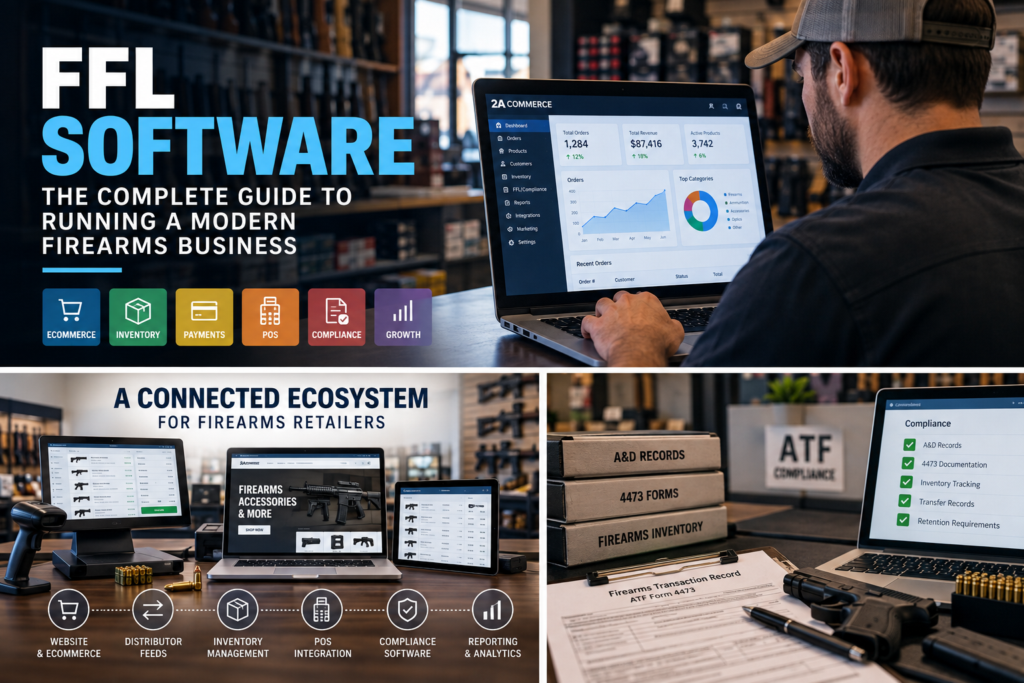
Running a firearms business requires more than a point-of-sale system and a website. Dealers need to coordinate inventory, ecommerce, compliance, customer records, payments, shipping, distributor data, and day-to-day operations without creating disconnected workflows. That is where specialized firearms-business technology becomes important.
The right software gives a dealer a central operational framework for managing the systems that keep a modern firearms business moving. Instead of treating the website, store, inventory, and compliance process as separate tools, a connected technology stack can reduce duplicated work and make it easier for employees to see what is happening across the business.
For growing dealers, the question is no longer whether software should be part of the operation. The real question is how to choose software that supports the way the business actually sells.
What Is FFL Software?
FFL software is business software designed for Federal Firearms License holders and other firearms-industry retailers. Depending on the platform, it may help manage inventory, ecommerce orders, point-of-sale activity, customer information, distributor feeds, operational reporting, and integrations with compliance-focused systems.
Not every platform performs every function. Some products concentrate on bound-book or compliance workflows. Others focus on retail operations, inventory, or POS. Ecommerce platforms can form another part of the stack by connecting the online storefront to those systems.
For that reason, dealers should think about the technology stack as an ecosystem rather than assuming one application must do everything.
A strong setup connects the tools that are best suited to each function while keeping information moving between them.
Why Firearms Dealers Need Specialized Software
A general retail store can often operate with a conventional ecommerce platform and POS system. Firearms businesses have additional requirements and workflows.
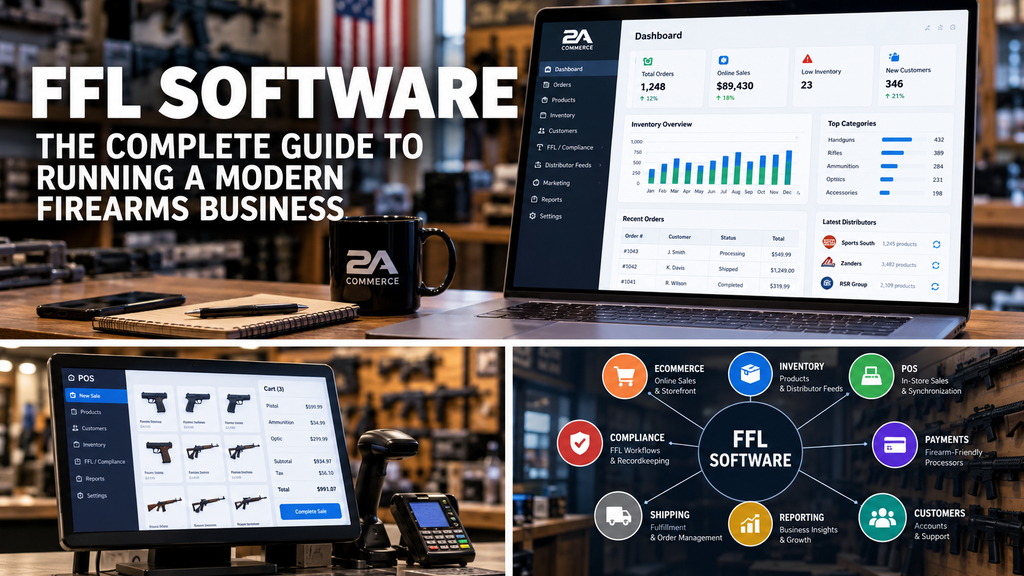
An FFL may need to coordinate physical inventory with online availability, manage products from multiple distributors, route online purchases through appropriate fulfillment processes, maintain required records, and use payment providers willing to support the firearms industry.
Generic retail technology may handle individual pieces of that workflow but often does not understand how they fit together.
Purpose-built firearms business software can help create a cleaner operational system by connecting the specialized services a dealer already depends on.
This becomes increasingly important as a business grows. A small shop may be able to update products manually. A larger dealer managing thousands of SKUs, distributor inventory, online orders, and in-store transactions needs automation and reliable data synchronization.
FFL Software and Compliance Workflows
Compliance is one of the most important considerations when evaluating firearms business technology.
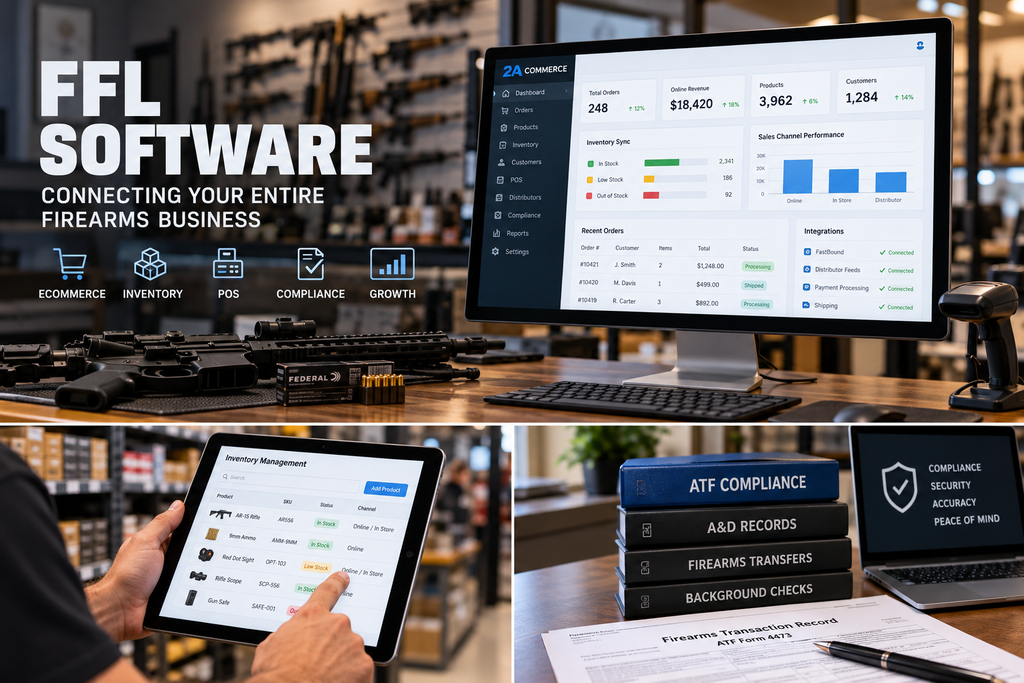
Federal firearms licensees have specific recordkeeping responsibilities. ATF guidance covers acquisition and disposition records, transaction records, retention requirements, and other responsibilities applicable to licensees. Dealers evaluating electronic systems should review the latest ATF Federal Firearms Licensee Quick Reference and Best Practices Guide along with any regulations or rulings applicable to their business.
Technology can support these processes, but software should never be viewed as a substitute for understanding the dealer’s legal responsibilities.
A useful platform should instead reduce unnecessary manual work and connect appropriately with the compliance systems the business chooses to use.
For example, a dealer may use dedicated compliance software for electronic bound-book functions while the ecommerce system manages products, orders, customers, and online transactions. Integration between those systems can eliminate repetitive data entry and reduce operational friction.
Inventory Management
Inventory is one of the biggest challenges for firearms retailers.
A store may simultaneously manage physical inventory, online inventory, accessories, serialized products, distributor catalogs, incoming orders, and products displayed across multiple sales channels.
When those systems are disconnected, overselling and inaccurate stock information become much more likely.
Effective inventory technology should help establish a reliable source of inventory information.
That does not necessarily mean every product must physically exist inside one application. Instead, the systems should communicate clearly enough that inventory changes can move through the business without constant manual updates.
For example, when a product sells in the store, the ecommerce inventory should reflect that change quickly. When an online product becomes unavailable, the storefront should stop presenting it as immediately available.
Inventory synchronization becomes even more valuable when distributor feeds are involved.
Dealers managing both local stock and ecommerce should understand how gun inventory software helps synchronize inventory across channels and distributor sources.
Distributor Feed Integration
Many firearms retailers rely on distributors to expand the number of products they can offer online.
Distributor feeds can contain large catalogs with product descriptions, images, availability, pricing, and other product data. Importing and maintaining that information manually can become unrealistic.
Software that works with distributor feeds can help automate product availability and catalog management.
The important distinction is that simply importing a feed is not enough.
A useful ecommerce workflow should give the dealer control over margins, product visibility, categories, inventory rules, and which distributor products actually appear on the website.
Without those controls, a massive feed can quickly become an unmanageable catalog.
The goal is not simply to publish more products. The goal is to create a storefront that accurately represents what customers can buy while keeping the underlying catalog manageable for the dealer.
Point-of-Sale Integration
For retailers with a physical storefront, the POS system is another major part of the technology stack.
The best technology strategy connects in-store activity with online activity instead of treating them as separate businesses.
A customer may research a product online and purchase it in the store. Another customer may place an order online while store staff simultaneously manage the same inventory.
If the POS and ecommerce systems cannot communicate, employees may spend significant time reconciling stock and orders manually.
Integration allows information to move between the systems and can create a more consistent view of the business.
Dealers evaluating platforms should ask whether their software can integrate with the POS they already use or whether switching systems would be required.
Retailers with physical locations should also evaluate gun store POS software based on inventory synchronization, ecommerce connectivity, reporting, and payment flexibility.
Ecommerce Capabilities
Modern firearms retailers need more than a digital catalog.
A useful ecommerce system should make it possible to manage products, accept eligible online transactions through appropriate payment services, handle fulfillment workflows, communicate with customers, and provide store staff with manageable order information.
FFL software should connect with the ecommerce layer instead of forcing the dealer to maintain two independent systems.
The website also needs room to grow.
Search engine optimization, landing pages, merchandising, email marketing, analytics, promotions, content, product filters, and conversion optimization all matter once the business begins competing seriously online.
A rigid platform may solve an immediate operational problem but create marketing limitations later.
That is why the ecommerce component should be evaluated both as business software and as a customer acquisition platform.
A broader gun store software strategy should connect the storefront with inventory, customers, POS activity, reporting, and other operational systems.
Payment Processing
Payment processing is another area where firearms retailers need specialized consideration.
Not every payment provider supports firearms businesses, and policies can vary depending on the products being sold and the merchant’s business model.
A practical FFL software setup should therefore allow the business to work with payment providers that understand and support the industry.
Dealers should evaluate more than the advertised processing rate. They should understand gateway compatibility, transaction fees, platform fees, chargeback handling, integration requirements, and restrictions that could affect the business.
The payment layer should fit into the broader ecommerce system without forcing the retailer into a provider that does not align with its business.
Shipping and Fulfillment
Online firearms retail involves different fulfillment scenarios depending on the product and transaction.
Operational software should help the store distinguish between orders that can follow ordinary ecommerce fulfillment and orders that require specialized handling.
A connected FFL software stack can make it easier for employees to see order status, shipping information, customer details, and fulfillment requirements from the same operational workflow.
This is especially valuable for stores handling a mix of firearms, accessories, apparel, optics, and other products.
Rather than forcing every order through the exact same path, the platform should support workflows appropriate to different product categories.
Customer Management
Firearms retailers are still retailers, and customer experience matters.
Customers expect order confirmations, shipping updates, clear account information, responsive support, and a website that makes products easy to find.
FFL software can contribute to that experience by keeping customer and order information organized.
When employees can quickly find an order and understand its status, support becomes easier. When ecommerce and operational systems communicate properly, customers are less likely to receive conflicting information.
The best technology is often invisible to the customer. They simply experience a smoother purchase process.
Reporting and Business Visibility
Dealers need to know what is selling and where growth is coming from.
Modern FFL software should make useful operational data accessible rather than trapping information inside isolated applications.
Depending on the technology stack, a business may want visibility into online revenue, product performance, inventory levels, order volume, conversion rates, customer acquisition channels, and distributor product performance.
Not all reporting needs to come from the same dashboard.
The more important requirement is that the platform integrates cleanly with analytics and reporting tools so management can make decisions using reliable information.
What to Look for When Choosing FFL Software
Choosing technology based on a feature checklist alone can lead to expensive mistakes.
Dealers should first map how their business operates today.
Consider where products originate, how inventory is updated, where sales occur, how compliance records are maintained, how online orders are processed, which payment system is used, and where employees repeatedly perform manual work.
Then evaluate FFL software against that workflow.
Important questions include:
- Can it integrate with the dealer’s existing compliance tools?
- Can it connect ecommerce and in-store operations?
- Can it support the distributor feeds the dealer uses?
- How does inventory synchronization work?
- Does it support appropriate payment-processing options?
- Can the website be optimized for SEO and conversion?
- Can integrations be expanded as the business grows?
- Who controls the website and its data?
- What happens when the dealer needs functionality that is not built into the platform?
These questions reveal far more than a long list of features.
Avoiding Disconnected Systems
One of the most common technology problems in retail is software fragmentation.
A business gradually adds a website, POS, payment gateway, inventory application, shipping platform, accounting software, marketing tools, and compliance systems.
Every individual tool may work well, yet the overall workflow becomes increasingly difficult to manage.
Good FFL software architecture reduces that fragmentation.
The objective should not necessarily be to eliminate every specialized application. Specialized systems often exist because they solve a particular problem extremely well.
Instead, the objective is integration.
When information can move reliably between the right systems, each application can perform its role without forcing employees to repeatedly copy information from one place to another.
This is where gun shop software becomes valuable: instead of adding another isolated application, the goal is to connect ecommerce, POS, inventory, payments, shipping, and compliance workflows.
Cloud-Based FFL Software
Cloud platforms have changed how retailers manage their businesses.
Instead of maintaining software only on a computer inside the store, employees may be able to access appropriate business systems from authorized devices and locations.
Cloud-based FFL software can simplify updates, integration, ecommerce management, and scalability, depending on the platform and the specific compliance function involved.
Security and access controls remain important.
Dealers should understand how data is stored, how user permissions work, how backups are handled, and which parts of the system are responsible for regulated records.
A cloud-first architecture can be valuable, but the implementation needs to fit the requirements of the business.
FFL Software for Growing Dealers
The technology that works for a new FFL may not be sufficient once the business grows.
More products create more inventory complexity. More orders create additional fulfillment work. More employees create permission and workflow challenges. More traffic exposes limitations in the website and hosting environment.
Scalable FFL software should allow the technology stack to expand without requiring the dealer to rebuild the entire operation every time the business reaches a new stage.
This is where integrations become particularly important.
A dealer may begin with ecommerce and a small physical inventory, then later add distributor feeds, advanced marketing automation, new payment options, additional shipping integrations, or a dedicated POS connection.
A flexible system provides room for that evolution.
Building a Connected Firearms Commerce Stack
The strongest technology strategy for a firearms retailer is usually not based on finding one application with the longest feature list.
It is based on building a connected stack.
The ecommerce platform should be strong at ecommerce. The compliance system should support the dealer’s regulatory workflow. The payment provider should understand firearms merchants. Inventory information should remain synchronized. Marketing tools should connect to customer acquisition and retention efforts.
FFL software sits at the center of that strategy by helping these systems function as one operational environment.
For dealers that want to compete online, the website should be treated as part of the core business infrastructure rather than simply another sales channel.
A well-built firearms commerce platform can connect products, customers, transactions, integrations, marketing, and operations while allowing specialized compliance systems to continue doing the jobs they were designed to do.
Dealers using specialized platforms should also consider how FFL software integrations connect systems such as FastBound, ecommerce, POS, inventory, distributor feeds, and fulfillment tools.
The Future of FFL Software
Firearms retail is becoming increasingly connected.
Customers move between search engines, ecommerce websites, physical stores, email, social media, and online product research before making a purchase.
Dealers need technology capable of supporting that journey.
At the same time, automation is making it possible to manage larger catalogs, synchronize distributor inventory, personalize marketing, analyze customer behavior, and reduce repetitive administrative tasks.
The next generation of FFL software will likely be judged less by how many isolated features it contains and more by how effectively it connects the retailer’s entire technology ecosystem.
Dealers that build that foundation now will be better positioned to add new technology without constantly rebuilding their operations.
Choosing the Right Foundation
There is no universal technology stack that fits every firearms dealer.
A home-based FFL, a local gun shop, a large ecommerce retailer, and a manufacturer may all require different systems.
The right FFL software should reflect the business model, current workflow, growth strategy, and existing tools of the dealer.
Start by identifying where manual work, disconnected data, and operational bottlenecks occur. Then look for technology that connects those areas rather than simply adding another application.
For firearms retailers building an online business, that means treating ecommerce, inventory, payments, integrations, marketing, and compliance workflows as parts of the same system.
When those pieces work together, technology stops being another operational burden and becomes infrastructure for growth.