
Why This Comparison Matters
At first glance, ecommerce is ecommerce.
You list products, customers add them to a cart, they check out, and you ship the order.
That’s how most people understand online selling.
But if you’re in the firearms industry, you already know that reality is very different.
The problem is that many businesses still try to apply traditional ecommerce logic to firearm sales—and that’s where things start to break.
Understanding the difference between firearms ecommerce and traditional ecommerce is not just helpful—it’s essential.
Because when you treat them the same, you end up with:
- Broken checkout flows
- Payment processing issues
- Compliance risks
- Poor customer experience
What makes this especially important is that these problems are not always obvious at the beginning. A store might appear to function correctly on the surface. Products are visible, orders can be placed, and payments may even go through initially.
But as soon as the business begins to grow or operate consistently, the cracks start to show.
Orders require manual corrections. Customers ask questions about what happens after purchase. Payment issues become more frequent. And operational inefficiencies begin to slow everything down.
At that point, the issue is no longer just technical—it becomes a business limitation.
This is why the comparison matters so much.
If you don’t clearly understand how firearms ecommerce differs from traditional ecommerce, you risk building your entire operation on a system that was never designed to support it.
And when that happens, you’re not just dealing with inconvenience—you’re creating friction at every level of your business.
From the customer’s perspective, confusion during checkout leads to hesitation. If they don’t fully understand how the process works, they are less likely to complete their purchase.
From an operational perspective, your team spends more time managing exceptions than processing orders. Instead of having a streamlined workflow, you’re constantly stepping in to fix gaps in the system.
From a risk perspective, improper handling of payments or compliance steps can lead to serious consequences, including account restrictions or disruptions in service.
This guide will break down exactly what makes firearms ecommerce different, what most platforms get wrong, and what you should be looking for instead.
What Is Traditional Ecommerce?
Traditional ecommerce refers to selling products online through standard platforms like Shopify, WooCommerce (default setups), or similar systems.
The workflow is simple:
- Customer selects a product
- Adds it to cart
- Enters shipping details
- Completes payment
- Product ships directly to the customer
This model works perfectly for most industries.
It’s fast, streamlined, and optimized for conversion.
Everything is designed to reduce friction. The fewer steps required, the better the conversion rate. The entire system is built around speed and simplicity.
But it’s built around one critical assumption:
The product can be shipped directly to the customer without additional regulatory steps.
This assumption drives every part of the system—from checkout design to payment processing to fulfillment.
For most industries, that works perfectly.
For firearms, it does not.
What Is Firearms Ecommerce?
Firearms ecommerce operates under a completely different structure.
The process includes:
- FFL dealer selection
- Compliance requirements
- Regulated delivery
- Additional customer responsibilities
Instead of shipping directly to the buyer, firearms must be transferred through a licensed dealer.
This introduces multiple steps that traditional ecommerce platforms simply don’t account for.
But beyond the additional steps, the real difference lies in how the entire transaction must be structured.
In firearms ecommerce, the purchase is not the final step—it’s part of a larger process.
The customer is not just buying a product. They are initiating a regulated transfer that involves:
- Selecting a licensed dealer
- Completing required procedures at that dealer
- Following specific legal requirements before taking possession
This means your ecommerce platform must do more than process a transaction. It must guide the customer through a process they may not fully understand.
If that guidance is missing, confusion increases.
If confusion increases, conversion drops.
And if the process is not handled correctly, operational issues follow.
This is where traditional ecommerce platforms fall short.
They are designed to complete a transaction—not to manage a regulated workflow.
Firearms ecommerce, on the other hand, requires a system that understands the entire lifecycle of the sale.
From the moment a customer lands on your site to the final transfer at the FFL dealer, every step must be structured, clear, and aligned with how firearm transactions actually work.
That’s the difference.
And that’s why this comparison matters.
If you want a complete breakdown of how these systems work together, read our full guide to firearm ecommerce and how to build a compliant online store.
The Core Difference: Workflow Complexity
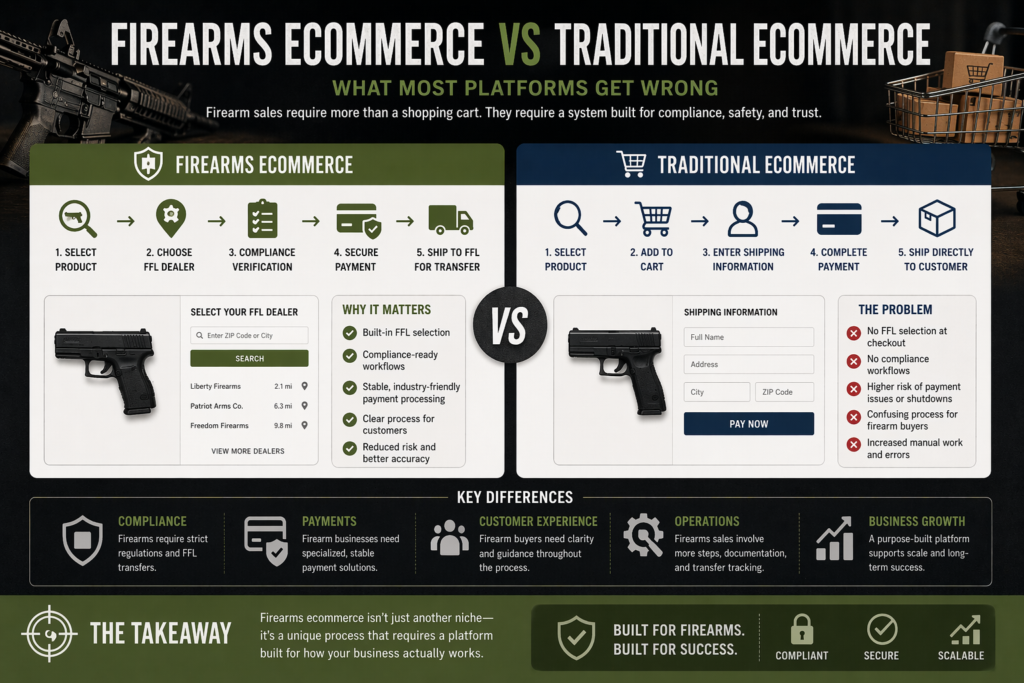
The biggest difference between firearms ecommerce and traditional ecommerce is workflow.
Traditional Ecommerce Flow
Storefront → Cart → Checkout → Payment → Shipping → Done
Firearms Ecommerce Flow
Storefront → Firearms Checkout → FFL Selection → Compliance → Payment → Transfer → Completion
This added complexity is where most platforms fail.
They try to force a traditional workflow onto a non-traditional process.
Where Traditional Platforms Break Down
Let’s look at the specific areas where traditional ecommerce platforms fail firearm businesses.
1. Checkout Is Not Built for Firearms
Traditional checkout systems are designed for speed.
But firearm transactions require structure.
Without proper support, you end up with:
- Missing FFL selection
- Confusing steps for customers
- Manual follow-ups after purchase
This creates friction and reduces conversions.
2. Payment Processing Risks
Most traditional platforms rely on standard payment providers.
But firearm businesses often face:
- Declined transactions
- Account freezes
- Sudden shutdowns
For additional insights into ecommerce operations and risk management, review this resource from the U.S. Small Business Administration.
Choosing the right platform is critical. In our guide to gun friendly ecommerce, we break down what to look for in a system that actually supports your business.
3. No Built-In Compliance Workflow
Traditional ecommerce platforms assume:
- You can ship directly to the customer
- There are no additional regulatory steps
This is not true for firearm sales.
Without built-in compliance:
- Orders require manual handling
- Errors increase
- Risk grows
4. Poor Customer Experience
Customers expect clarity.
But when platforms aren’t designed for firearms:
- Checkout becomes confusing
- Instructions are missing
- Customers hesitate
This leads to abandoned carts and lost revenue.
Firearms Ecommerce vs Traditional Ecommerce (Side-by-Side)
| Feature | Traditional Ecommerce | Firearms Ecommerce |
|---|---|---|
| Checkout | Simple | Structured |
| Shipping | Direct | Via FFL |
| Payments | Standard | Specialized |
| Compliance | Minimal | Required |
| Workflow | Linear | Multi-step |
What Most Platforms Get Wrong
Mistake #1: Treating Firearms Like Any Other Product
This leads to broken systems and compliance gaps.
Mistake #2: Relying on Plugins to Fix Everything
Trying to patch a traditional platform with plugins often results in:
- Fragile systems
- Compatibility issues
- Constant maintenance
These limitations are not accidental—they come from using systems that were never designed for firearm sales. In this breakdown of why ecommerce platforms fail firearm businesses, we explain the root problems and how 2A Commerce fixes them.
Mistake #3: Ignoring Payment Risk
This is one of the fastest ways to disrupt your business.
Mistake #4: Overcomplicating the Process
When systems aren’t designed properly, complexity increases unnecessarily.
What a Proper Firearms Ecommerce System Looks Like
A true firearms ecommerce system is designed from the ground up.
It includes:
- Built-in firearms checkout
- Integrated FFL selection
- Compliance-ready workflows
- Stable payment processing
Instead of adapting a generic system, it aligns with your business.
But beyond these core features, what really defines a proper firearms ecommerce system is how seamlessly everything works together. It’s not just about having the right components—it’s about how those components interact within a single, structured workflow.
A well-designed system eliminates guesswork. It guides both your team and your customers through each step of the process without confusion or manual intervention.
For example, when a customer reaches checkout, the system should naturally guide them to select an FFL dealer, understand the transfer process, and complete their purchase with confidence. At the same time, your backend should automatically capture and organize all necessary information so your team doesn’t need to follow up or correct orders manually.
This level of alignment is what separates a functional store from an efficient business system.
It also reduces dependency on technical fixes. Instead of constantly adjusting plugins or troubleshooting integrations, your platform simply works the way it’s supposed to—consistently and predictably.
The Advantage of Purpose-Built Platforms
When your platform is designed for firearms ecommerce:
- Checkout becomes intuitive
- Orders flow correctly
- Payments are stable
- Compliance is structured
This reduces friction across your entire operation.
But the advantage goes beyond operational improvements.
A purpose-built platform creates consistency. Every order follows the same structured process. Every customer experiences the same clear journey. Every transaction is handled within a system designed for your industry.
This consistency leads to fewer surprises—both for your team and your customers.
It also improves training and onboarding. New team members can quickly understand how the system works because it follows a logical, repeatable structure. There’s no need to learn multiple disconnected tools or rely on undocumented processes.
From a customer perspective, this consistency builds trust. When buyers understand what’s happening at each step, they feel more confident completing their purchase.
And in firearm ecommerce, trust plays a major role in conversion.
The Business Impact of Getting It Right
When you choose the right system:
- Conversion rates increase
- Operational workload decreases
- Customer trust improves
- Growth becomes scalable
But these benefits don’t happen all at once—they compound over time.
At first, you may notice fewer support requests and smoother order processing. Then, as your store grows, the impact becomes more significant. Your team can handle higher order volumes without additional complexity. Your customers move through checkout without hesitation. Your operations remain stable even as demand increases.
This creates a strong foundation for long-term growth.
Instead of constantly fixing problems or adapting to limitations, you’re building momentum. Your system supports your business instead of slowing it down.
Over time, this difference becomes a competitive advantage.
While other businesses struggle with fragmented setups and operational friction, you’re able to focus on scaling, marketing, and improving your customer experience.
Choosing the Right Foundation for Your Business
Firearms ecommerce is not a variation of traditional ecommerce—it’s a completely different model.
Trying to force a traditional platform to handle firearm sales will always create friction.
The difference between struggling and scaling often comes down to one decision:
Choosing a system that is built for how your business actually operates.
When your platform matches your workflow, everything becomes more efficient. You gain control over your operations, confidence in your processes, and the ability to grow without constantly running into technical or operational barriers.
That’s what a proper firearms ecommerce system provides—not just functionality, but a foundation for sustainable growth.
And in an industry where complexity is unavoidable, having the right foundation is what makes everything else possible.