
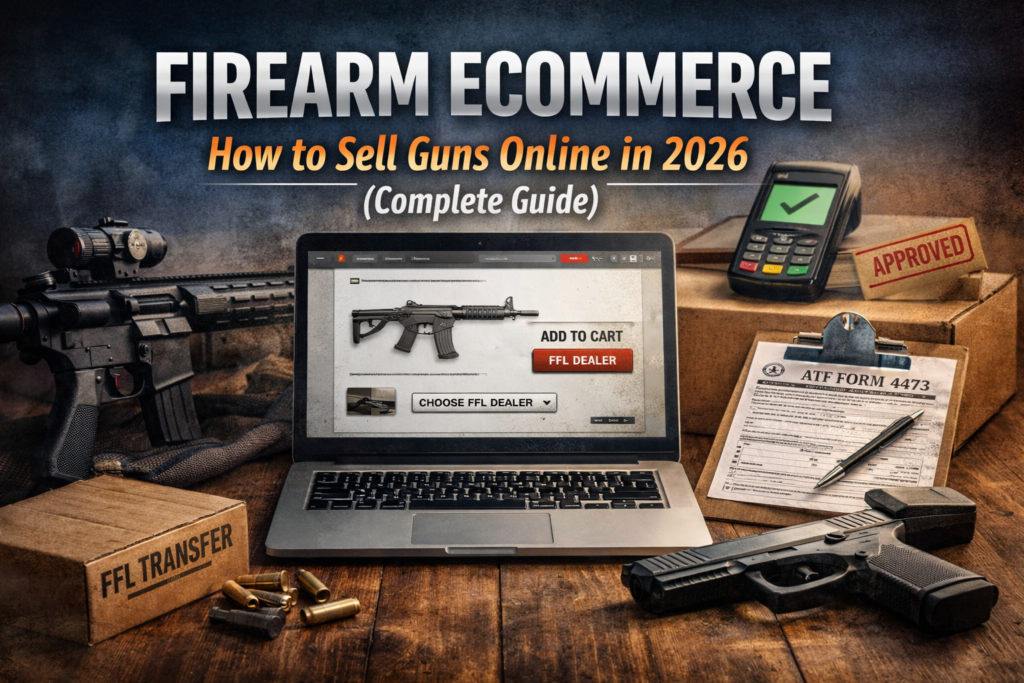
Introduction: The Reality of Selling Firearms Online
If you’re trying to sell firearms online, you’ve probably realized something quickly:
This is not like launching a typical ecommerce store.
Most platforms weren’t built for your business model. Payment processors hesitate. Compliance requirements are complex. And even when you get everything working, one wrong move can shut things down overnight.
What makes this even more challenging is that many of these issues don’t appear until after you’ve already invested time and money into your store. You might launch successfully, start getting orders, and then suddenly run into payment issues, compliance gaps, or operational bottlenecks that force you to rethink everything.
That’s why understanding firearm ecommerce is critical before you build—or rebuild—your online store.
A successful setup isn’t just about having a website. It’s about having a system that supports how your business actually operates, from the moment a customer lands on your storefront to the final transfer at a licensed dealer.
In this guide, we’ll break down exactly how firearm ecommerce works in 2026, what most businesses get wrong, and how to create a system that actually supports how you sell. More importantly, we’ll simplify the process so you can see how all the moving parts connect, without getting lost in technical details.
What Is Firearm Ecommerce?
At its core, firearm ecommerce refers to selling firearms, accessories, and related products online while complying with federal, state, and local regulations.
But in practice, it’s much more than just listing products on a website.
A true firearm ecommerce system must handle:
- FFL dealer selection at checkout
- Compliance workflows for transfers
- Payment processing that supports your business
- Order tracking tied to regulated delivery processes
- Inventory and documentation requirements
At its core, firearm ecommerce refers to selling firearms, accessories, and related products online while complying with federal, state, and local regulations, as outlined by the Bureau of Alcohol, Tobacco, Firearms and Explosives (ATF).
Beyond these technical components, firearm ecommerce also requires clear communication with customers. Buyers need to understand what happens after they place an order, where their firearm will be shipped, and what steps they must complete before taking possession. If this process isn’t clearly explained, it leads to confusion, support requests, and even canceled orders.
Unlike traditional ecommerce, firearm ecommerce is not just about selling—it’s about selling within a regulated framework. Every step must be intentional, structured, and aligned with how firearm transactions actually work in the real world.
If you’re still comparing options, this breakdown of firearms ecommerce vs traditional ecommerce explains why most platforms fail to support firearm sales.
Why Traditional Ecommerce Platforms Fail Firearm Businesses
Many gun store owners start with popular ecommerce platforms. On the surface, they seem powerful and flexible.
But here’s the problem:
They’re not designed for firearm ecommerce.
Not all platforms are truly built for this industry. In our guide to gun friendly ecommerce, we break down what to look for in a platform that actually supports firearm businesses.
Missing FFL Integration
Standard platforms don’t support selecting an FFL dealer during checkout. This creates manual work, errors, and compliance risks.
Instead of a seamless experience, store owners often rely on emails, phone calls, or follow-ups to collect dealer information. This slows down the process and increases the chances of mistakes that can impact order fulfillment.
Payment Processing Issues
Many processors integrated into mainstream platforms may:
- Decline firearm-related transactions
- Freeze accounts
- Terminate service without warning
This is one of the biggest pain points in firearm ecommerce. Even businesses that are fully compliant can run into sudden disruptions simply because their payment setup isn’t aligned with their industry.
Compliance Is Not Built-In
You’re left patching together plugins, custom code, and manual processes just to meet basic requirements.
This creates a fragile system where small issues can lead to bigger problems. Instead of focusing on growing your business, you end up managing technical workarounds and constant adjustments.
Broken Customer Experience
Customers expect a smooth buying process. Instead, they get:
- Confusing checkout steps
- Missing instructions
- Delays in order fulfillment
When the process isn’t clear, trust is lost. Customers may abandon their purchase or feel uncertain about what happens next. In firearm ecommerce, clarity and confidence are essential—not optional.
The Core Components of a Firearm Ecommerce System
To succeed in firearm ecommerce, your store must function as a complete system, not just a website.
Let’s break down the essential components.
1. Storefront (Your Online Gun Store)
Your storefront is where customers browse and select products.
A strong firearm ecommerce storefront should include:
- Clear product categorization
- Compliance-friendly product pages
- Mobile optimization
- Fast load times
But most importantly, it should prepare customers for what comes next in the buying process.
2. Firearms Checkout (Where Everything Changes)
This is where firearm ecommerce diverges from standard ecommerce.
Instead of a simple checkout, you need:
- FFL selection
- Clear instructions for transfer
- Customer acknowledgment of compliance steps
Break your flow into a simple story:
Storefront → Firearms Checkout → FFL Selection → Compliance → Payment → Completion
When this flow is clear, customers feel confident—and conversions increase.
3. FFL Selection and API Integration
A critical part of firearm ecommerce is allowing customers to choose a licensed dealer (FFL) for shipment.
This typically involves:
- Accessing a database of FFL dealers
- Allowing users to search by location
- Storing dealer information with the order
With proper integration (often via an FFL API), this process becomes seamless.
Without it, you’re relying on emails, phone calls, and manual verification.
4. Compliance Workflow
Once an order is placed, the compliance process begins.
This includes:
- Verifying the FFL dealer
- Ensuring proper documentation
- Tracking transfer status
A strong firearm ecommerce system automates as much of this as possible.
5. Payment Processing
This is one of the most critical—and misunderstood—parts of firearm ecommerce.
You need a system that:
- Supports your product category
- Processes transactions reliably
- Does not interrupt your business
6. Order Management and Fulfillment
Once payment is complete, your system must:
- Route the order correctly
- Send it to the selected FFL
- Track delivery and status
This is where integration with systems like FastBound or similar tools becomes valuable.
How Firearm Ecommerce Actually Works (Step-by-Step)
Let’s simplify the entire process.
Step 1: Customer Browses Store
They explore products like any ecommerce site.
Step 2: Adds Firearm to Cart
Nothing unusual yet.
Step 3: Checkout Begins
Now the process changes.
Step 4: Selects FFL Dealer
Customer chooses where the firearm will be shipped.
Step 5: Completes Payment
Using a compatible payment system.
Step 6: Order Is Routed
Store sends firearm to selected FFL.
Step 7: Customer Completes Transfer
Final step happens at the dealer.
Common Mistakes in Firearm Ecommerce
Trying to “Make It Work” With Generic Tools
This leads to:
- Broken workflows
- Compliance risks
- Poor customer experience
Many of these issues come from using the wrong foundation. In this article on why most ecommerce platforms fail firearm businesses, we explain where things break—and how 2A Commerce solves it.
Ignoring Payment Risk
Choosing the wrong processor can:
- Freeze funds
- Shut down your store
- Damage your reputation
Overcomplicating the Checkout
More confusion = fewer conversions.
Lack of Clear Communication
Customers need to understand:
- What happens after purchase
- Where the firearm is shipped
- What steps they must take
What a Modern Firearm Ecommerce Platform Should Offer
A complete firearm ecommerce platform should provide:
Built-In Firearms Checkout
No custom patchwork required.
Integrated FFL Selection
Seamless dealer search and selection.
Compliance-Ready Structure
Designed for how firearm transactions work.
Stable Payment Processing
No surprises or interruptions.
Scalable Infrastructure
Supports growth as your business expands.
Firearm Ecommerce vs Traditional Ecommerce
| Feature | Traditional Ecommerce | Firearm Ecommerce |
|---|---|---|
| Checkout | Simple | Multi-step with FFL |
| Shipping | Direct to customer | Via FFL dealer |
| Payments | Standard processors | Specialized support |
| Compliance | Minimal | High |
| Workflow | Linear | Structured |
This is why firearm ecommerce requires a different approach.
How to Choose the Right Firearm Ecommerce Platform
When evaluating options, ask:
1. Does it support FFL selection natively?
If not, you’ll be patching things together.
2. Is payment processing included or compatible?
This is critical.
3. Is the system built for compliance?
Or are you responsible for figuring that out?
4. Can it scale with your business?
You don’t want to rebuild later.
The Advantage of an Integrated System
Instead of combining multiple tools, modern firearm ecommerce platforms bring everything together.
This creates:
- Better performance
- Fewer errors
- Improved user experience
- Faster setup
If you’re looking for a ready-to-launch solution, explore our ecommerce platform built specifically for this industry.
How Firearm Ecommerce Impacts Your Growth
When done correctly, firearm ecommerce allows you to:
- Expand beyond local sales
- Reach a national audience
- Increase order volume
- Streamline operations
But only if your system supports it.
SEO and Marketing for Firearm Ecommerce
Getting traffic is just as important as having the right platform.
Key strategies include:
- Targeting industry-specific keywords
- Creating helpful content
- Building authority in your niche
To drive consistent traffic, this guide to firearm SEO explains how to rank your store in search results.
Future Trends in Firearm Ecommerce
Looking ahead, firearm ecommerce will continue evolving.
🔹 More Automation
Compliance and workflows will become more streamlined.
🔹 Better Integrations
Systems will communicate more efficiently.
🔹 Improved User Experience
Checkout flows will become simpler and clearer.
Final Thoughts
Firearm ecommerce is not just about selling products online—it’s about building a system that supports your business from start to finish.
The difference between struggling and scaling often comes down to one thing:
Whether your platform is built for how you actually operate.
When everything works together—storefront, checkout, FFL integration, compliance, and payments—you don’t just have a website.
You have a business engine.