
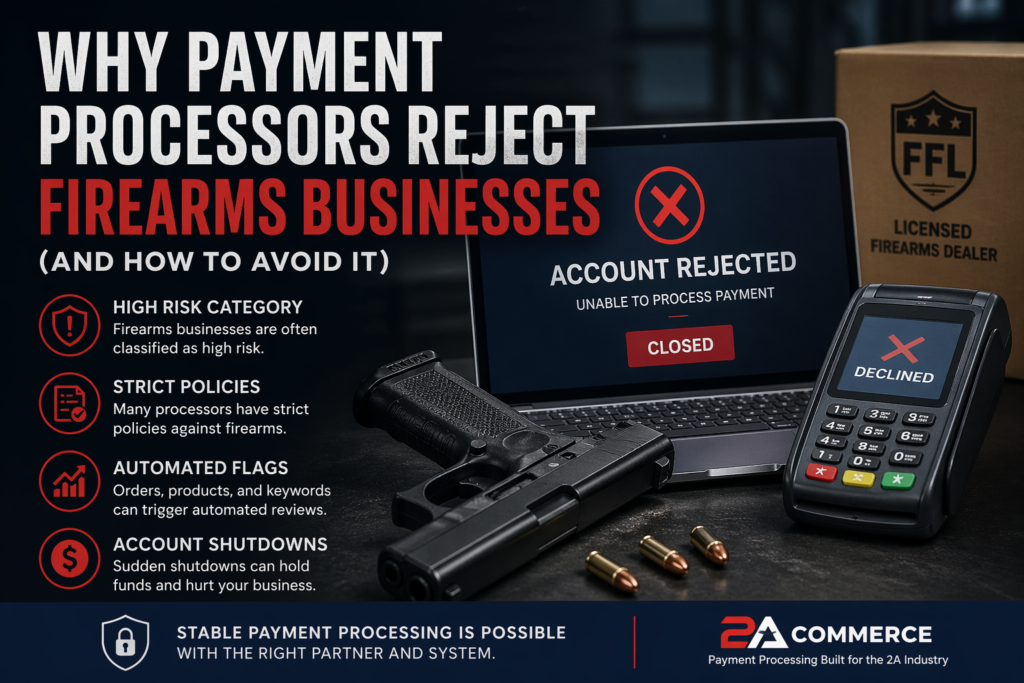
Introduction: The Real Risk Behind Firearms Payment Processing
One of the biggest challenges in firearms payment processing is not getting approved—it’s staying approved.
Many firearms businesses launch their store, connect a payment provider, and begin processing orders without issues. Then, without warning, problems start to appear.
Transactions fail. Accounts are flagged. Funds are held. In some cases, payment processing is completely shut down.
This pattern is not uncommon.
Understanding why payment processors reject firearms businesses is essential if you want to build a stable and reliable payment system.
Because in this industry, the risk isn’t just interruption—it’s complete disruption of your ability to operate.
The Core Problem: Misalignment in Firearms Payment Processing
Most payment processors are not designed for firearms payment processing.
They are built for:
- Low-risk retail
- Digital transactions
- Simple ecommerce flows
Firearms businesses operate differently.
They involve:
- Compliance requirements
- FFL transfers
- Multi-step fulfillment processes
This creates a mismatch between what the processor expects and how your business actually functions.
That mismatch is the root reason payment processors reject firearms businesses.
Why Firearms Businesses Are Classified as High Risk
From the perspective of financial institutions, firearms payment processing falls into a high-risk category.
To see how financial institutions evaluate risk across different industries, you can review this overview of risk management for financial institutions.
This classification is based on several factors:
Regulatory complexity
Firearms transactions involve federal and state compliance requirements.
Transaction structure
Orders often include third-party FFL transfers and delayed fulfillment.
Risk modeling
Even compliant businesses may be grouped into higher-risk categories based on industry.
Policy limitations
Many providers simply choose not to support firearms businesses.
These factors contribute to why payment processors reject firearms businesses, even when the business itself operates responsibly.
How Automated Systems Trigger Rejections
Modern payment providers rely heavily on automation.
Their systems analyze:
- Transaction behavior
- Product categories
- Volume changes
- Customer activity
Firearms transactions often fall outside expected patterns.
When this happens, the system flags the account.
This is one of the most common reasons payment processors reject firearms businesses—not because of wrongdoing, but because the system does not understand the context.
Approval Does Not Mean Stability
A major misconception in firearms payment processing is that approval equals safety.
It doesn’t.
Many providers:
- Approve accounts quickly
- Perform limited initial checks
- Reassess risk after transactions begin
Once real data is analyzed, accounts may be flagged.
This delayed evaluation explains why payment processors reject firearms businesses after they have already been operating successfully.
Common Triggers That Lead to Shutdowns
Understanding these triggers helps you avoid them.
Misclassification
If your business is not properly categorized, your activity may conflict with your profile.
Transaction changes
Sudden increases in volume or changes in behavior can trigger alerts.
Product-level flags
Certain items may be flagged within broader categories.
FFL workflow complexity
Multi-step fulfillment can appear inconsistent to processors.
Policy updates
Processors can change their policies at any time.
Each of these factors contributes to why payment processors reject firearms businesses—and why stability requires more than just approval.
Why Generic Platforms Fail for Firearms Payment Processing
Generic platforms are optimized for simplicity, not specialization.
They assume:
- Direct transactions
- Immediate fulfillment
- Minimal compliance variation
Firearms businesses do not fit this model.
This leads to:
- Frequent account reviews
- Increased risk flags
- Eventual shutdowns
Even if a provider initially supports your business, it may not sustain your firearms payment processing needs long-term.
Link to Blog #4
For a broader overview of your options, this complete guide to merchant services for firearms businesses compares different providers and how they fit your needs.
The Real Cost of Getting Shut Down
When payment processing fails, the consequences extend beyond transactions.
Financial impact
- Funds may be held
- Cash flow is interrupted
- Revenue is lost
Operational impact
- Checkout stops functioning
- Orders cannot be completed
- Customer experience suffers
Reputational impact
- Trust declines
- Support issues increase
- Brand perception is affected
This is why understanding firearms payment processing at a deeper level is critical.
What a Stable Firearms Payment Processing Setup Looks Like
Stability comes from alignment.
A reliable system includes:
- A provider that understands firearms businesses
- Proper classification during onboarding
- Transaction flows that match your operations
- Compliance built into your process
If you want to avoid these issues entirely, this complete guide to firearms payment processing explains how to build a stable and compliant setup.
Choosing the Right Providers Matters
Not all providers approach this industry the same way.
Some are designed to support firearms businesses.
Others only allow them temporarily.
If you’re looking for solutions that actually work, this guide to gun-friendly merchant services breaks down the providers that support firearms businesses.
For businesses handling FFL transfers, our post on FFL credit card processing explains what to consider before choosing a provider.
If you’re looking for solutions that actually work, this guide to gun-friendly merchant services breaks down the providers that support firearms businesses.
Why 2A Commerce Offers a More Reliable Approach
The biggest issue with firearms payment processing is not just the processor—it’s the system behind it.
Most businesses rely on disconnected tools:
- One for checkout
- One for payments
- One for compliance
This creates instability.
2A Commerce takes a different approach.
Instead of patching together systems, it provides an integrated solution built specifically for firearms businesses.
This means:
- Payment processing aligns with real workflows
- FFL integration is built into the system
- Compliance is considered from the start
You are not relying on a generic processor that might shut you down.
You are using a system designed for long-term stability in firearms payment processing.
That’s the difference between temporary approval and reliable operation.
Building a Payment System That Supports Your Business
Avoiding shutdowns is not about avoiding risk entirely—it’s about managing it correctly.
A stable firearms payment processing setup requires:
- The right provider
- Proper onboarding
- System alignment
- Ongoing monitoring
When these elements work together, your payment system becomes predictable.
Instead of reacting to problems, you operate with confidence.