
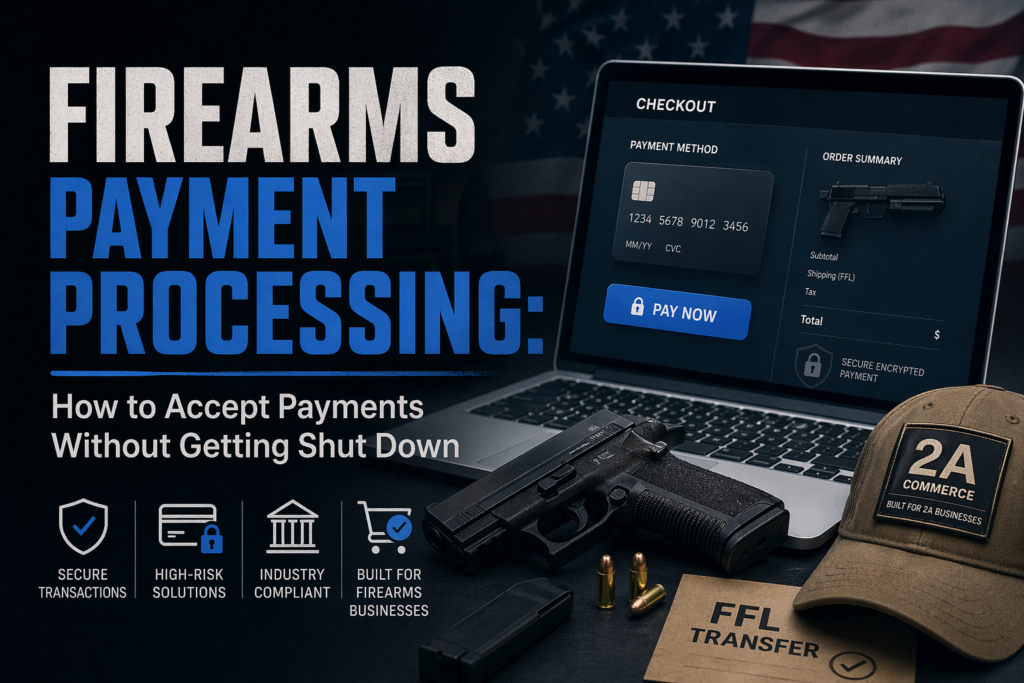
Why Firearms Payment Processing Is Different
If you operate a firearms business, you already understand that accepting payments is not as straightforward as it is in other industries.
Standard ecommerce tools and payment providers are not built with your business model in mind. Many firearm retailers launch their store using familiar platforms, connect a well-known processor, and assume everything is set up correctly—until they experience a sudden shutdown.
Accounts are frozen without warning. Funds are held. Orders fail to process. In many cases, businesses are left scrambling to recover.
This is the reality of firearms payment processing when it is not handled correctly.
The issue is not your legitimacy or compliance. The issue is relying on systems that were never designed to support how firearms businesses actually operate.
In this guide, you will learn:
- Why firearms businesses are often rejected or shut down
- How payment processing in this industry actually works
- What to look for when choosing a provider
- Common mistakes that lead to instability
- How to build a reliable system that supports long-term growth
Why Firearms Businesses Get Shut Down by Payment Processors
Most traditional payment processors are designed for low-risk industries. Their policies, risk models, and automated systems are not built to accommodate firearms-related transactions.
Even if your account is initially approved, that approval does not guarantee long-term stability.
Common reasons for shutdowns
Category restrictions
Many providers explicitly restrict or prohibit firearms transactions. Others allow them temporarily but later reassess risk and terminate accounts.
Compliance concerns
Firearms sales involve federal and state regulations. Many processors choose to avoid this complexity entirely rather than manage the risk.
Automated risk systems
Modern processors rely heavily on automated monitoring. Accounts can be flagged and shut down without human review.
Misaligned business classification
If your business is not properly categorized during onboarding, it can trigger issues later—even if you were initially approved.
Chargeback assumptions
Some processors associate firearms businesses with higher risk, even if your actual chargeback rate is low.
The key takeaway is simple: you can be fully compliant and still lose your payment processing if your provider is not aligned with your industry.
What Makes Firearms Payment Processing Unique
To build a stable system, it is important to understand why this category requires a different approach.
Regulatory complexity
Firearms transactions often involve:
- Federal Firearms License (FFL) transfers
- Background checks
- State-specific compliance requirements
These layers add complexity that most payment systems are not designed to handle.
Non-standard order flow
Unlike traditional ecommerce:
- The buyer may not be the final recipient
- Orders may be shipped to an FFL dealer
- Delivery involves additional verification steps
Your payment system must support this structure without creating friction or risk.
Higher scrutiny from financial institutions
Banks and processors apply stricter underwriting standards to firearms businesses. This affects:
- Approval timelines
- Documentation requirements
- Ongoing monitoring
Business model mismatch
Most payment systems are built for:
- Simple retail
- Digital goods
- Standard shipping models
They are not built for:
- Firearms transfers
- Compliance-driven workflows
- Multi-step order fulfillment
This mismatch is the root cause of many payment failures.
Types of Payment Processing Options for Firearms Businesses
Understanding your options helps you make better decisions.
High-risk merchant account providers
These providers specialize in industries that traditional processors avoid.
For a broader understanding of how high-risk merchant accounts are classified and why certain industries are treated differently, you can review this guide on high-risk merchant accounts.
Advantages:
- Higher likelihood of approval
- Better understanding of compliance requirements
Considerations:
- Higher processing fees
- More detailed underwriting
- Longer onboarding process
Offshore processors
Some businesses explore offshore options to bypass restrictions.
Advantages:
- Easier initial approval
Risks:
- Lower trust with customers
- Potential delays in payouts
- Increased long-term instability
Aggregators (mainstream platforms)
Examples include Stripe, PayPal, and Square.
Advantages:
- Fast setup
- Simple integration
Risks:
- High likelihood of shutdown
- Limited support for firearms businesses
- Funds may be held if issues arise
Firearms-specific solutions
These systems are designed specifically for the industry.
Advantages:
- Aligned with real business workflows
- More stable long-term
- Built-in compliance considerations
Considerations:
- Fewer providers available
- May require a more structured setup
How Underwriting Works for Firearms Payment Processing
Underwriting is one of the most important—and misunderstood—parts of the process.
When you apply for a merchant account, the provider evaluates your business before approving you.
What underwriters look for
- Business type and industry classification
- Website content and product offerings
- Compliance with firearms regulations
- Processing history (if available)
- Expected monthly volume
Why firearms businesses get flagged
Firearms businesses are often flagged due to:
- Industry classification (high-risk category)
- Regulatory complexity
- Misalignment between business model and processor capabilities
Common underwriting requirements
You may be asked to provide:
- Business registration documents
- Identification for owners
- Bank statements
- Product and pricing information
- Website review access
Why approvals fail
Applications are often rejected because:
- The provider does not support firearms businesses
- The business is incorrectly categorized
- Documentation is incomplete
- The risk profile does not align with the provider’s policies
Understanding underwriting helps you avoid delays and choose the right partner from the start.
How to Set Up Firearms Payment Processing (Step-by-Step)
A structured approach reduces risk and improves long-term stability. Setting up firearms payment processing correctly from the beginning is one of the most important decisions you can make for your business.
Step 1: Define your business model
Before applying for any provider, you need a clear understanding of how your business operates. This is a critical foundation for successful firearms payment processing.
Clearly outline:
- What products you sell
- How orders are fulfilled
- Whether FFL transfers are involved
Providers evaluate your setup based on risk, and accurate positioning improves your chances of stable firearms payment processing approval.
Step 2: Choose the right provider
Not all providers are suitable for firearms businesses. Selecting the right partner is essential for long-term firearms payment processing success.
Focus on:
- Industry experience
- Stability over time
- Transparency in terms and fees
A provider that understands firearms workflows will significantly reduce the risk of interruptions in your firearms payment processing setup.
Step 3: Complete underwriting
Underwriting is where many businesses fail. To secure reliable firearms payment processing, you must provide accurate and complete information.
Provide:
- Correct business classification
- Clear product descriptions
- Full documentation
This step is critical because your long-term firearms payment processing stability depends on proper approval.
Step 4: Integrate with your store
Your firearms payment processing system must work seamlessly with your store’s structure.
Ensure your payment system works with:
- Your checkout flow
- FFL selection process
- Order management system
Poor integration is one of the most common causes of failure in firearms payment processing, especially when systems are patched together.
Step 5: Test transactions
Before going live, thoroughly test your firearms payment processing setup.
Run tests to:
- Simulate real orders
- Confirm payment flow
- Validate order processing
Testing ensures your firearms payment processing system performs correctly under real conditions.
Step 6: Monitor performance
After launch, ongoing monitoring is essential to maintain stable firearms payment processing.
Track:
- Transaction success rates
- Processor alerts
- Compliance updates
Consistent monitoring helps you identify issues early and protect your firearms payment processing infrastructure.
Warning Signs Your Payment Setup Is at Risk
Even after approval, problems can arise. Recognizing early warning signs can help you protect your firearms payment processing system before a shutdown occurs.
Key warning signs
- Sudden increase in declined transactions
- Requests for additional documentation
- Delayed payouts
- Account reviews without explanation
These are often indicators that your firearms payment processing provider is reassessing your account.
Risk factors to avoid
- Using processors that do not clearly support firearms businesses
- Misrepresenting your products during onboarding
- Mixing unrelated product categories
- Rapid spikes in transaction volume without notice
Avoiding these issues helps maintain stable firearms payment processing and reduces long-term risk.
What Happens When a Processor Shuts You Down
Understanding the impact reinforces why proper firearms payment processing setup is essential.
Immediate effects
- Payments stop processing
- Checkout becomes unusable
- Orders cannot be completed
Financial impact
- Funds may be held for weeks or months
- Cash flow is disrupted
- Refunds and disputes become difficult
Operational disruption
- Customer trust declines
- Support requests increase
- Business continuity is affected
A failed firearms payment processing setup can halt your entire operation, which is why choosing the right system from the beginning is critical.
What to Look for in a Reliable Payment Processing Setup
When evaluating options, focus on long-term stability and alignment with firearms payment processing requirements.
Industry alignment
Your provider should understand:
- Firearms compliance
- FFL workflows
- Order fulfillment structure
Transparent pricing
Look for:
- Clear fee structure
- No hidden charges
- Predictable costs
Integration capability
Your firearms payment processing system should:
- Work seamlessly with your store
- Support your checkout flow
- Align with your operational needs
Stability and support
Choose providers that offer:
- Consistent service
- Clear communication
- Long-term reliability
Reliable support is a key component of maintaining stable firearms payment processing.
Why a Unified System Matters
Many businesses attempt to piece together different tools for firearms payment processing, which creates unnecessary risk.
They rely on:
- One system for checkout
- Another for payments
- Another for compliance
This fragmented approach leads to:
- Integration issues
- Operational complexity
- Increased chance of failure
A unified system ensures your firearms payment processing works seamlessly with every part of your business.
A Reliable and Secure Approach to Firearms Payment Processing
At this point, most firearms businesses realize the issue isn’t just finding a processor—it’s finding a system that actually supports firearms payment processing as a whole.
That’s where 2A Commerce comes in.
Instead of relying on disconnected tools, 2A Commerce provides a unified solution where firearms payment processing is built specifically for firearms businesses. Everything is designed to align with how your business actually operates—from checkout to compliance to order flow.
This means you’re not relying on generic processors that can shut you down without warning. You’re using a system designed for stability, security, and long-term growth in firearms payment processing.
Payment processing is not treated as an add-on. It’s part of a complete infrastructure built for this industry.
Firearms Payment Processing Is Only One Part of the System
Firearms payment processing is critical, but it is only one piece of the puzzle.
Your entire ecommerce system needs to be designed for how firearms businesses operate.
Of course, firearms payment processing is only one part of the equation—your entire store needs to be built for this industry. This complete guide to firearms ecommerce platforms explains how everything works together.
Of course, payment processing is only one part of the equation—your entire store needs to be built for this industry. This complete guide to firearms ecommerce platforms explains how everything works together.
INTERNAL LINKING
Supporting #1
Gun-Friendly Merchant Services: What Actually Works in 2026
📍 Place it here:
Inside section:
👉 “Types of Payment Processing Options for Firearms Businesses”
If you want a deeper breakdown of which providers actually work in this industry, this guide to gun-friendly merchant services explains what to look for and what to avoid.
Supporting #2
FFL Credit Card Processing: What You Need to Know Before Choosing a Provider
📍 Place it here:
Inside section:
👉 “What Makes Firearms Payment Processing Unique”
(or right after mentioning FFL transfers)
If your business involves FFL transfers, this guide to FFL credit card processing explains what you need to consider before choosing a provider.
Supporting #3 (MOST IMPORTANT)
Why Most Payment Processors Reject Firearms Businesses
📍 Place it here:
Inside section:
👉 “Why Firearms Businesses Get Shut Down by Payment Processors”
To understand this in more detail, this breakdown of why most payment processors reject firearms businesses explains the most common causes behind sudden shutdowns.
Supporting #4
Merchant Services for Firearms Businesses: Complete Guide
📍 Place it here:
Inside section:
👉 “What to Look for in a Reliable Payment Processing Setup”
For a broader overview of available options, this complete guide to merchant services for firearms businesses covers different providers and how they compare.