
Why “Gun-Friendly Ecommerce” Matters More Than Ever
If you’re researching gun friendly ecommerce platforms, you’re already ahead of most firearm businesses.
Many store owners start with general ecommerce solutions, assuming they can adapt them to fit their needs. At first, everything seems fine—products are listed, the site looks good, and orders start coming in.
But then the problems begin.
Payments get flagged. Checkout becomes confusing. Compliance steps are unclear. Orders require manual follow-ups. And in some cases, entire accounts are shut down without warning.
What makes this even more frustrating is that these issues don’t usually appear immediately. Everything may seem stable during the early stages, which creates a false sense of security. Then, as volume increases or as transactions become more consistent, the underlying limitations of the platform start to surface.
This is where the concept of gun friendly ecommerce becomes critical.
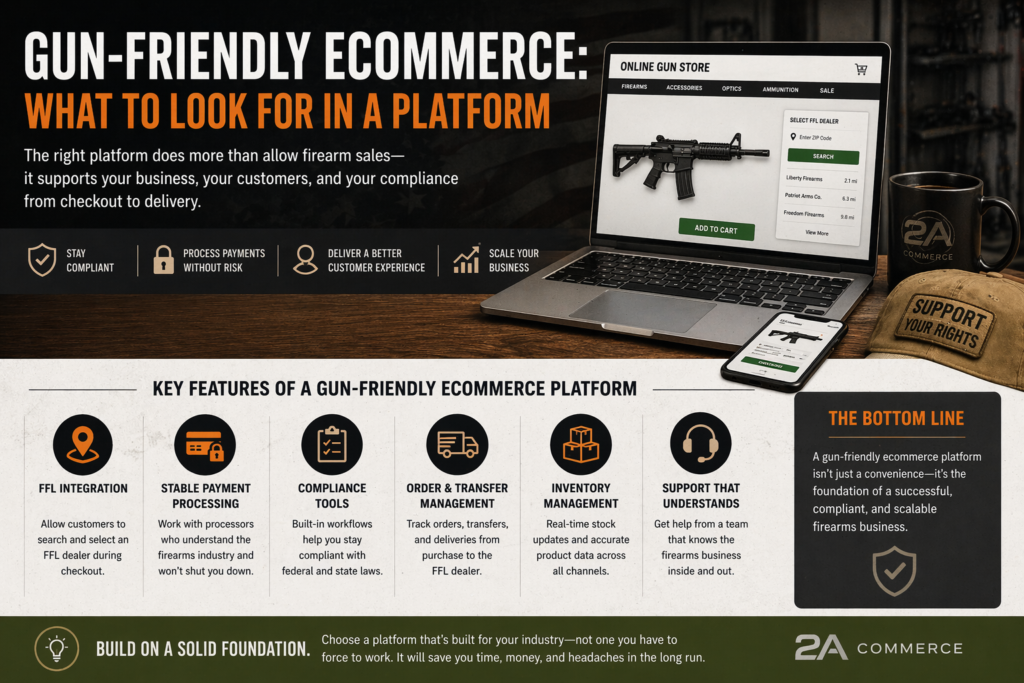
A gun friendly ecommerce platform is not just one that “allows” firearm sales. It’s one that is intentionally built to support how firearm businesses actually operate—across checkout, compliance, payments, and fulfillment.
In other words, it’s not about whether you can sell—it’s about whether your system is designed so you can sell consistently, reliably, and without constant friction.
When your platform is not aligned with your business model, every part of your operation becomes harder than it should be:
- Your team spends time fixing issues instead of growing the business
- Customers become confused during checkout and abandon purchases
- Orders require manual intervention, increasing errors and delays
- You constantly worry about whether your payment setup will hold
Over time, these inefficiencies compound. What starts as a small inconvenience becomes a bottleneck that limits your growth.
On the other hand, when you use a true gun friendly ecommerce platform, everything changes.
Your checkout flow becomes clear and predictable. Customers understand what to do. Orders move through a structured process. Payment processing becomes stable. Compliance is built into the system instead of being handled manually.
This creates something most firearm businesses never experience with generic platforms: operational confidence.
You’re no longer reacting to problems—you’re running a system that works the way it should from the start.
If you get this decision wrong, you don’t just deal with inconvenience—you risk your entire operation.
If you get it right, everything becomes simpler, more scalable, and more profitable.
Why Most Ecommerce Platforms Are Not Gun-Friendly
Let’s address a common misconception:
Not all ecommerce platforms are truly gun friendly.
Some may allow firearm-related products under certain conditions, but that doesn’t mean they support your workflow.
Many of these limitations come from treating firearm sales like standard ecommerce. This breakdown of firearms ecommerce vs traditional ecommerce explains where most platforms fall short.
This is where many businesses get caught off guard. They see that a platform doesn’t explicitly prohibit firearm-related sales, and they assume it’s a viable solution. But “not prohibited” is very different from “purpose-built.”
The Difference Between “Allowed” and “Supported”
Allowed means you might not get banned immediately.
Supported means the platform is designed for your business.
This distinction is where most firearm businesses run into trouble.
A platform that simply allows firearm-related products often lacks the deeper infrastructure required to actually support your operations. It might let you list products, but it doesn’t guide the transaction process in a way that aligns with real-world requirements.
A truly gun friendly ecommerce platform, on the other hand, is built with those requirements in mind from the ground up.
A platform that is not truly gun friendly ecommerce will often fail in key areas:
- No FFL selection at checkout
- Limited or unstable payment processing
- Lack of compliance workflows
- Poor communication with customers
But beyond these functional gaps, there’s also a strategic issue.
When your platform isn’t built for your industry, you’re constantly adapting your business to fit the limitations of the technology. Instead of the platform supporting your workflow, your workflow becomes constrained by the platform.
That’s the opposite of what you want.
The right gun friendly ecommerce platform should adapt to your business—not the other way around.
When that alignment exists, everything becomes more efficient, more predictable, and ultimately more scalable.
For a complete breakdown of how these systems work together, read our full guide to firearm ecommerce and how to build a compliant online store.
What Defines a Gun-Friendly Ecommerce Platform?
A true gun friendly ecommerce platform is designed around your workflow—not adapted after the fact.
Let’s break down the key components.
1. Built-In Firearms Checkout Flow
The checkout process is where most platforms fail.
In traditional ecommerce:
- Customer enters shipping info
- Pays
- Order ships
In gun friendly ecommerce:
- Customer selects an FFL dealer
- Understands transfer steps
- Completes a structured checkout process
A proper platform must:
- Integrate FFL selection directly into checkout
- Clearly guide the customer
- Reduce confusion and abandonment
If this isn’t built-in, you’ll end up creating workarounds that break over time.
2. FFL Integration (Not Optional)
FFL selection is not a feature—it’s a requirement.
A strong gun friendly ecommerce system should:
- Provide a searchable FFL database
- Allow location-based selection
- Automatically attach dealer info to orders
Without this, your team will:
- Chase down dealer details manually
- Risk incorrect shipments
- Create delays in fulfillment
3. Payment Processing That Actually Works
This is one of the most important parts of gun friendly ecommerce.
Many business owners assume payment processing is solved once a gateway is connected.
That’s not the case.
You need:
- A processor that supports your product category
- Stable transaction handling
- No unexpected account disruptions
4. Compliance-Ready Infrastructure
Gun friendly ecommerce platforms must support compliance—not leave it up to you.
This includes:
- Order tracking aligned with FFL transfers
- Documentation handling
- Clear workflows for regulated sales
Without built-in compliance, you’re constantly managing risk.
For broader payment security and compliance standards, review the PCI Security Standards Council’s PCI DSS overview.
5. Customer Experience That Builds Trust
In firearm ecommerce, the buying process is different.
Customers need clarity.
A good gun friendly ecommerce platform ensures:
- Clear checkout steps
- Transparent instructions
- Confidence in the process
If customers are confused, they hesitate—or abandon the purchase entirely.
6. Integration with Industry Tools
Modern firearm businesses rely on multiple systems.
Your platform should integrate with:
- FFL APIs
- Compliance tools
- Inventory systems
- Order management tools
This creates a unified system instead of disconnected parts.
7. Scalability for Growth
Many stores outgrow their initial setup.
A true gun friendly ecommerce platform should:
- Handle increasing order volume
- Support new product lines
- Expand without requiring a rebuild
Comparing Gun-Friendly Ecommerce vs Traditional Platforms
| Feature | Traditional Ecommerce | Gun-Friendly Ecommerce |
|---|---|---|
| Checkout | Basic | Structured with FFL |
| Payments | Standard | Industry-compatible |
| Compliance | Manual | Built-in |
| Workflow | Generic | Industry-specific |
Common Mistakes When Choosing a Platform
Choosing Based on Price Alone
Cheap platforms often cost more in the long run due to:
- Fixes
- Workarounds
- Lost revenue
Ignoring Payment Compatibility
This can shut your business down overnight.
Overlooking Customer Experience
If the process isn’t clear, customers won’t complete it.
Trying to Patch Everything Together
Multiple plugins ≠ a system.
These issues usually come from using the wrong foundation. In this article on why most ecommerce platforms fail firearm businesses, we break down the root problems—and how 2A Commerce solves them.
How to Evaluate a Gun-Friendly Ecommerce Platform
Ask these questions:
- Does it support FFL selection natively?
- Is payment processing stable and compatible?
- Is compliance built into the system?
- Is the checkout flow optimized for firearms sales?
- Can it scale with my business?
Why an Integrated Approach Wins
Instead of combining multiple tools, a modern gun friendly ecommerce system brings everything together:
- Checkout
- FFL selection
- Payments
- Compliance
At first glance, using separate tools might seem flexible. You can pick different plugins, services, and integrations to build your setup piece by piece.
But in practice, this approach creates complexity.
Each tool operates independently. Updates can break connections. Data doesn’t always sync properly. And when something goes wrong, it’s difficult to identify where the issue actually is.
What starts as a flexible setup quickly turns into a system that requires constant attention. Even small changes—like a plugin update or a payment gateway adjustment—can disrupt the entire workflow.
This often leads to:
- Time spent troubleshooting instead of growing
- Increased risk of errors in orders and transfers
- Inconsistent customer experiences
- Ongoing maintenance and hidden costs
Another major issue with disconnected systems is accountability. When multiple tools are involved, there’s no single source of truth. If an order fails, a payment doesn’t go through, or an FFL selection isn’t saved correctly, you’re left trying to trace the problem across several platforms.
This slows down operations and creates uncertainty within your team.
An integrated gun friendly ecommerce platform eliminates these problems by designing everything to work together from the start.
Instead of forcing connections between separate systems, the platform provides a unified workflow where every step is aligned.
This creates:
- Better performance
- Fewer errors
- Higher conversion rates
But beyond these technical benefits, integration creates something even more valuable: clarity.
Your team knows how orders flow. Your customers understand what to expect. Your business operates on a predictable system instead of a collection of moving parts.
It also improves decision-making. When your data, orders, and processes are all connected, you gain better visibility into what’s working and where improvements can be made. This allows you to optimize your store with confidence instead of guessing.
That level of clarity is what allows firearm businesses to scale without constantly running into operational friction.
Building a System That Supports Growth
Choosing the right gun friendly ecommerce platform is one of the most important decisions you’ll make for your business.
It affects:
- Your operations
- Your customer experience
- Your ability to scale
A platform that is truly built for firearm businesses doesn’t just help you sell products—it supports the entire lifecycle of each transaction, from the moment a customer lands on your site to the final transfer at an FFL dealer.
When your system is aligned with your business model, everything becomes more efficient. You spend less time fixing issues and more time focusing on growth. Customers move through checkout with confidence. Orders are processed correctly the first time.
As your business grows, this alignment becomes even more important. What works for a handful of orders per week can quickly break down at higher volumes if the system isn’t designed properly. An integrated platform ensures that your operations remain stable as demand increases.
Over time, this creates a compounding advantage.
Instead of constantly adapting to limitations, you’re building on a foundation that supports your business as it grows.
And in a space as complex as firearm ecommerce, that foundation is what separates businesses that struggle from those that scale successfully.