
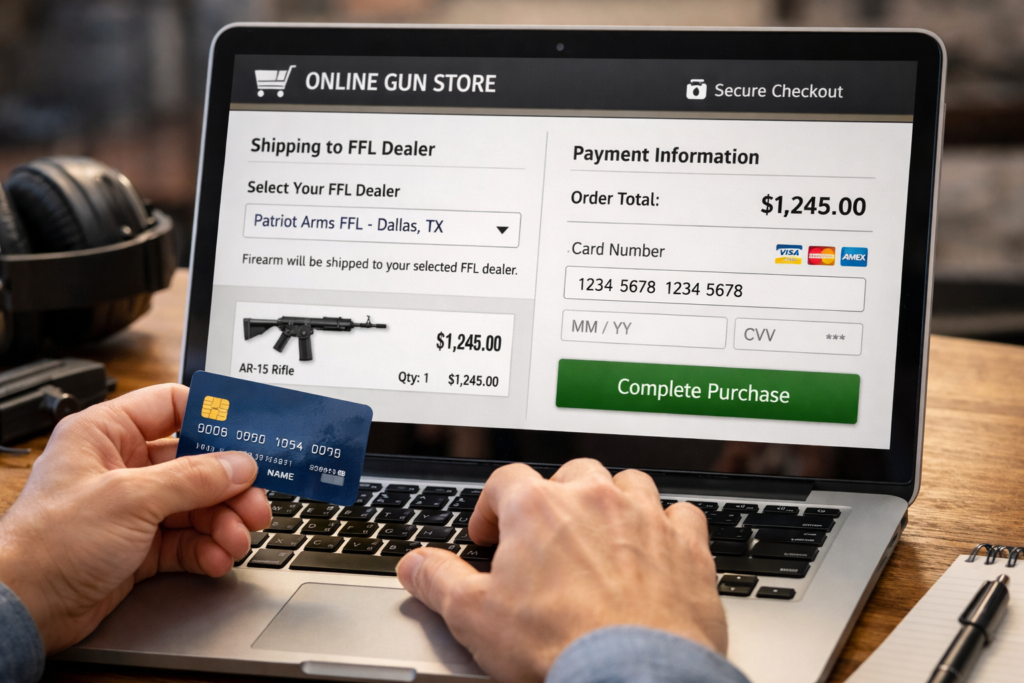
Running a firearm business today requires more than inventory and compliance knowledge. Whether you operate a physical gun store, an online firearm shop, or both, one of the biggest operational challenges is finding FFL credit card processing that works reliably and remains compliant with industry regulations.
Many gun stores quickly discover that traditional payment processors are not always friendly to firearms businesses. Banks, merchant service providers, and payment gateways often place firearms retailers into a high-risk category, which can result in rejected applications, account shutdowns, or excessive fees.
This is why gun retailers often rely on providers that offer gun friendly credit card processing designed specifically for firearm businesses.
This guide explains everything gun store owners need to know about FFL credit card processing, including how it works, why firearm businesses face unique challenges, how FFL EZ Check affects ecommerce transactions, and how to implement a stable payment solution for both retail and online
sales.
Why Gun Stores Need Specialized Payment Processing
A typical retail business can open a merchant account with almost any payment processor. Firearm businesses operate in a different environment.
Even though selling firearms legally with a Federal Firearms License (FFL) is perfectly legitimate, the payment industry treats firearms as a restricted category.
That means gun stores often face:
• higher underwriting scrutiny
• additional compliance checks
• stricter chargeback monitoring
• specialized merchant service providers
Because of these factors, gun dealers must often rely on FFL credit card processing providers that understand the firearms industry and are willing to support it.
Without a compatible payment processor, a gun store may struggle to accept:
• online payments
• credit card payments in store
• recurring payments for memberships
• firearm ecommerce transactions
Many firearm retailers look specifically for payment providers that support firearm merchants. If you’re researching payment solutions designed for gun stores, our guide to FFL friendly credit card processing explains how these specialized merchant services work.
How FFL Credit Card Processing Works
At its core, FFL credit card processing functions similarly to standard merchant services. When a customer pays with a credit card, several systems work together to complete the transaction.
The process typically includes:
1️⃣ The payment gateway
2️⃣ The merchant account provider
3️⃣ The acquiring bank
4️⃣ The card network (Visa, Mastercard, etc.)
5️⃣ The issuing bank
However, for firearm businesses, the merchant account must be configured specifically to support the sale of firearms, ammunition, or related accessories.
If a payment processor does not support firearms merchants, transactions can be flagged or blocked entirely.
This is why choosing the right FFL credit card processing provider is essential for long-term stability.
How Merchant Accounts Work for Firearm Businesses
To understand how FFL credit card processing works in practice, it helps to understand the role of the merchant account. A merchant account is the financial account that allows a business to accept credit and debit card payments.
When a customer enters their card information during checkout, the payment gateway securely transmits the transaction details to the merchant processor. The processor then communicates with the card networks such as Visa or Mastercard and the issuing bank that provided the customer’s card.
For firearm retailers, the merchant account must be approved specifically for firearm sales. This is important because some processors automatically flag transactions related to firearms, ammunition, or gun accessories if the merchant account is not configured correctly.
Gun stores using FFL credit card processing providers typically go through a more thorough underwriting process. The processor may request documentation such as:
• Federal Firearms License verification
• business registration documents
• website review for compliance
• product inventory verification
Although this process may seem more complicated than typical ecommerce merchant account approvals, it ensures that the firearm retailer operates legally and within the processor’s acceptable use policies.
Once approved, the merchant account allows the gun store to accept credit card payments both in-store and online.
Why Firearm Businesses Are Considered High Risk
One of the most common questions gun store owners ask is why their business is categorized as “high risk” by many payment processors.
The classification does not necessarily reflect the legality of the business. Instead, it is based on risk models used by banks and payment networks.
Firearm merchants may be considered higher risk because of:
• regulatory scrutiny
• policy differences between processors
• chargeback concerns
• reputational risk for financial institutions
Because of these factors, some mainstream payment platforms choose not to support firearms merchants at all.
However, specialized providers offering FFL credit card processing are structured to support firearm retailers and understand the compliance requirements involved in selling firearms.
This is why many gun stores prefer working with payment providers that specialize in firearm merchants rather than generic ecommerce processors.
The Biggest Challenges Gun Stores Face With Payment Processing
Many firearm retailers discover the challenges of FFL credit card processing only after they attempt to set up a merchant account.
Some of the most common problems include:
Payment Processor Restrictions
Many mainstream processors prohibit firearm sales outright. Businesses sometimes unknowingly sign up with a processor that later shuts down their account once firearms transactions are detected.
High Risk Merchant Classification
Even when firearm businesses are accepted, they are often classified as high risk. This classification can result in:
• higher transaction fees
• rolling reserves
• longer settlement periods
Compliance and Verification
Payment processors that support firearm businesses often require documentation confirming that the merchant operates legally under a valid FFL.
This ensures that the merchant is authorized to sell firearms and related products.
Online Firearms Sales and Payment Compliance
Selling firearms online introduces additional requirements beyond basic FFL credit card processing.
Unlike typical ecommerce stores, firearms cannot simply be shipped directly to the buyer.
Before a firearm can be shipped, the seller must verify that the receiving dealer holds a valid Federal Firearms License using systems such as FFL EZ Check.
This means the ecommerce checkout flow must incorporate:
• FFL selection
• dealer verification
• transfer compliance
This is where systems like FFL EZ Check become critical.
Firearm Ecommerce Checkout Workflow
The checkout experience for an online gun store differs significantly from a typical ecommerce website. Firearms cannot simply be purchased and shipped directly to the customer’s home.
Instead, firearm purchases must be transferred through a licensed dealer. Because of this requirement, firearm ecommerce checkout flows include additional steps beyond traditional ecommerce platforms.
A typical firearm ecommerce checkout process includes:
Step 1: Product Selection
The customer selects a firearm from the online store’s catalog. Many firearm ecommerce websites integrate distributor inventory feeds that automatically update product availability.
Step 2: FFL Dealer Selection
During checkout, the customer must choose a licensed FFL dealer who will receive the firearm shipment. Many ecommerce firearm platforms include a searchable database of dealers to simplify this process.
Step 3: Payment Processing
Once the dealer is selected, the payment is processed through a compatible FFL credit card processing provider.
The payment processor must allow firearm transactions and support ecommerce workflows specific to firearm retailers.
Step 4: Dealer Verification
Before the firearm ships, the retailer verifies the receiving dealer using systems such as FFL EZ Check.
Step 5: Shipment to Dealer
The firearm is shipped to the selected licensed dealer.
Step 6: Customer Background Check
The buyer completes the required background check and paperwork at the dealer location before taking possession of the firearm.
Because of these additional steps, firearm ecommerce platforms require specialized infrastructure to support the full workflow.
This is why implementing FFL credit card processing alongside compliant ecommerce software is critical for online firearm retailers.
What Is FFL EZ Check?
FFL EZ Check is a verification system operated by the Bureau of Alcohol, Tobacco, Firearms and Explosives (ATF). It allows firearm sellers to confirm that a Federal Firearms License is valid before shipping a firearm to that dealer.
For ecommerce gun stores, integrating FFL EZ Check into the checkout process helps verify the receiving dealer.
When a customer purchases a firearm online, the process typically works like this:
1️⃣ The buyer selects a firearm product
2️⃣ During checkout they select a licensed FFL dealer
3️⃣ The seller verifies the license using FFL EZ Check
4️⃣ The firearm ships to the licensed dealer for transfer
Gun sellers can verify dealer licenses directly through the ATF FFL EZ Check system.
Because of this workflow, FFL credit card processing for ecommerce stores must integrate smoothly with FFL selection and verification systems.
Firearms Ecommerce and Payment Processing
Gun stores increasingly rely on ecommerce platforms to sell firearms, ammunition, and accessories.
However, not every ecommerce system supports the requirements of firearm businesses.
A firearms ecommerce platform must support:
• FFL dealer selection during checkout
• FFL verification workflows
• compliant payment processing
• inventory synchronization with distributors
• firearm transfer compliance
Without these features, even the best FFL credit card processing setup can break down.
Many gun stores therefore use specialized ecommerce solutions built specifically for firearms retailers.
Why Many Gun Stores Use Industry-Specific Merchant Providers
Standard payment providers often lack experience with firearms businesses.
Specialized merchant service providers understand the regulatory environment and typically offer:
• firearm-friendly merchant accounts
• compliant ecommerce payment gateways
• integration with firearm industry software
• reduced risk of account shutdowns
A stable FFL credit card processing solution helps gun stores operate with confidence and avoid interruptions to sales.
Choosing the Right Payment Processor for Gun Stores
Selecting a payment provider requires evaluating several factors.
Firearm Industry Experience
The processor should already support firearms merchants and understand compliance requirements.
Ecommerce Compatibility
If you sell online, your processor must integrate with your ecommerce platform and support firearm-specific checkout workflows.
Transparent Pricing
Look for processors that clearly explain fees and avoid hidden charges.
Chargeback Protection
Firearm retailers should ensure their FFL credit card processing provider includes tools to help prevent chargebacks.
Payment Processing for Brick-and-Mortar Gun Stores
Physical gun stores require payment solutions that integrate with their point-of-sale systems.
In-store payment processing often includes:
• POS terminals
• inventory management systems
• integrated merchant services
A reliable FFL credit card processing system ensures in-store transactions remain fast and secure.
Payment Processing for Online Gun Stores
Online firearm retailers require additional infrastructure.
An ecommerce firearm store typically requires:
• compliant payment gateway
• FFL dealer selection system
• distributor inventory feeds
• automated tax calculation
• shipping compliance workflows
When these systems work together, FFL credit card processing becomes seamless for customers.
The Role of Firearms Ecommerce Platforms
Because firearms businesses operate under unique regulations, many retailers choose ecommerce platforms built specifically for the firearms industry.
These platforms typically integrate:
• firearm-friendly payment processing
• distributor feeds
• dealer locator tools
• compliance workflows
This approach simplifies implementing FFL credit card processing and ensures transactions remain compliant.
Payment Gateways Compatible with Firearm Ecommerce
The payment gateway is the technology that connects your website checkout page to the merchant processor.
When a customer enters their credit card information online, the gateway securely transmits that data to the payment processor.
For firearm ecommerce stores, the gateway must support the unique requirements of FFL credit card processing.
A firearm-friendly gateway should provide:
• secure payment encryption
• fraud prevention tools
• compatibility with firearm merchant accounts
• integration with ecommerce platforms
Many standard ecommerce gateways restrict firearm transactions. Gun store owners must therefore choose gateways that specifically support firearm merchants.
When paired with the right merchant account provider, a compatible gateway ensures that firearm transactions are processed securely and reliably.
Best Practices for Gun Store Payment Processing
To ensure long-term stability, firearm retailers should follow several best practices.
Work With Firearm-Friendly Providers
Avoid processors that have unclear policies about firearms.
Maintain Compliance Documentation
Payment processors may request FFL verification and compliance documents.
Monitor Chargebacks Carefully
Chargeback ratios can affect merchant account stability.
Choose the Right Ecommerce Platform
Firearm-specific ecommerce platforms simplify compliance and support FFL credit card processing more effectively.
Building the Complete Technology Stack for Online Gun Stores
Successful firearm ecommerce stores rely on a complete technology stack that integrates multiple systems together.
Payment processing is only one part of the infrastructure required to operate a compliant online firearm store.
A typical firearm ecommerce technology stack includes:
Firearm Ecommerce Platform
A platform built to support firearm compliance requirements, including dealer selection and transfer workflows.
Distributor Inventory Feeds
Many gun stores use automated feeds from distributors such as RSR Group, Sports South, or other wholesalers to synchronize product inventory.
FFL Dealer Locator Tools
Dealer locator databases allow customers to select licensed dealers during checkout.
Compliance Systems
Verification tools such as FFL EZ Check ensure firearms are shipped only to licensed dealers.
Firearm-Friendly Payment Processing
Finally, the store must integrate FFL credit card processing that allows firearm transactions and supports ecommerce checkout workflows.
When these systems work together, gun stores can operate efficiently while maintaining compliance with industry regulations.
The Future of FFL Credit Card Processing
The firearms industry continues to evolve as ecommerce becomes more common. More gun stores now rely on online sales, distributor integrations, and automated compliance tools.
As the industry grows, payment providers that understand firearm businesses are becoming increasingly important.
Reliable FFL credit card processing enables gun stores to focus on customer service, compliance, and growth rather than worrying about payment disruptions.
Why Choosing the Right Ecommerce Platform & the Right FFL Credit Card Processing Provider Matters
One of the biggest mistakes firearm retailers make when launching an online store is choosing a generic ecommerce platform without considering firearm compliance requirements.
Standard ecommerce systems often lack the features necessary for firearm retailers, including dealer selection workflows and compatible payment processing integrations.
Platforms designed specifically for firearm retailers solve these problems by combining ecommerce tools with compliance features.
These systems can include:
• FFL dealer databases
• distributor integrations
• firearm-friendly payment gateways
• compliance workflows
• firearms-specific checkout systems
By combining these tools with reliable FFL credit card processing, gun stores can provide a smooth purchasing experience for customers while remaining compliant with federal regulations.
For firearm businesses planning to sell online, selecting the right ecommerce infrastructure is just as important as choosing the right payment processor.
Additional Resources for Firearm Payment Processing
If you’re building or improving a firearm ecommerce store, the following guides provide more detailed information about compliance, dealer verification, and payment infrastructure for gun stores.
- FFL Friendly Credit Card Processing – how firearm businesses safely accept credit card payments
- FFL EZ Check Guide – how gun stores verify federal firearms licenses before shipping firearms
- Gun Friendly Credit Card Processing – payment processing solutions designed specifically for firearm merchants
Accepting credit cards as a firearm retailer requires more planning than many other industries. Between regulatory compliance, ecommerce workflows, and payment processor policies, gun stores must carefully select the right technology stack.
A reliable FFL credit card processing solution ensures that firearm businesses can accept payments securely while remaining compliant with industry regulations.
By combining firearm-friendly merchant services, compliant ecommerce infrastructure, and proper FFL verification workflows such as FFL EZ Check, gun stores can create a stable payment environment that supports both retail and online sales.
For firearm retailers looking to grow online, building the right technology stack — including payment processing, ecommerce infrastructure, and compliance tools — is essential for long-term success.